

Authors Moussaoui A et al
Cureus 18(10): e118457. doi:10.7759/cureus.118457
Abstract
Floor-of-mouth hematoma is an exceptionally rare but life-threatening complication of anticoagulation. A 67-year-old woman receiving rivaroxaban 20 mg/day for cardioembolic prevention in the setting of a cardiac rhythm disorder and two previous ischemic strokes presented with severe inspiratory dyspnea and respiratory distress. Examination showed a diffuse floor-of-mouth hematoma. Urgent flexible nasofibroscopy demonstrated marked epiglottic and supraglottic edema with critical narrowing of the laryngeal inlet, making orotracheal intubation impossible. An immediate rescue tracheostomy secured the airway. Rivaroxaban was discontinued; neither andexanet alfa nor four-factor prothrombin complex concentrate was available at our center. After 48 hours of intensive care monitoring, the hematoma and airway edema regressed. The patient was successfully decannulated on day seven, and rivaroxaban was resumed without early recurrence. This case highlights an exceptionally uncommon rivaroxaban-associated bleeding site and the decisive role of immediate airway control.
Introduction
Upper-airway hematoma is a rare complication of anticoagulation that can rapidly become fatal. Only isolated rivaroxaban-associated lingual, epiglottic, and retropharyngeal hematomas have been reported [1-5]. A spontaneous asphyxiating hematoma centered on the floor of the mouth is therefore an exceptional presentation. We report this case to emphasize early recognition and the priority of immediate airway protection.
Case Presentation
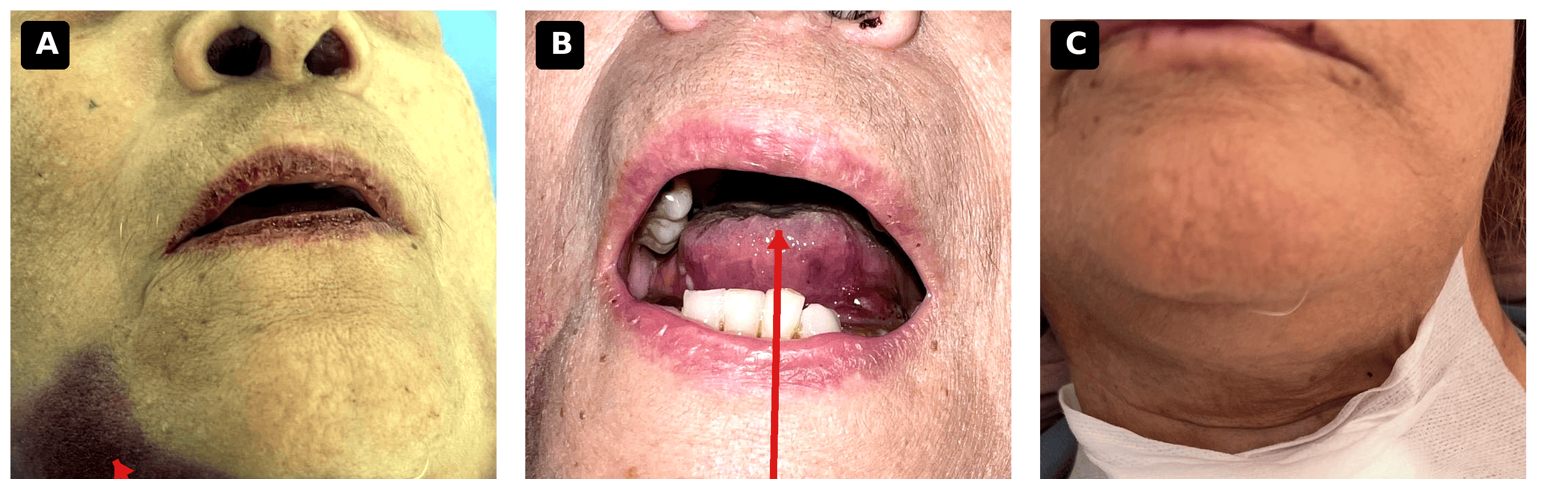
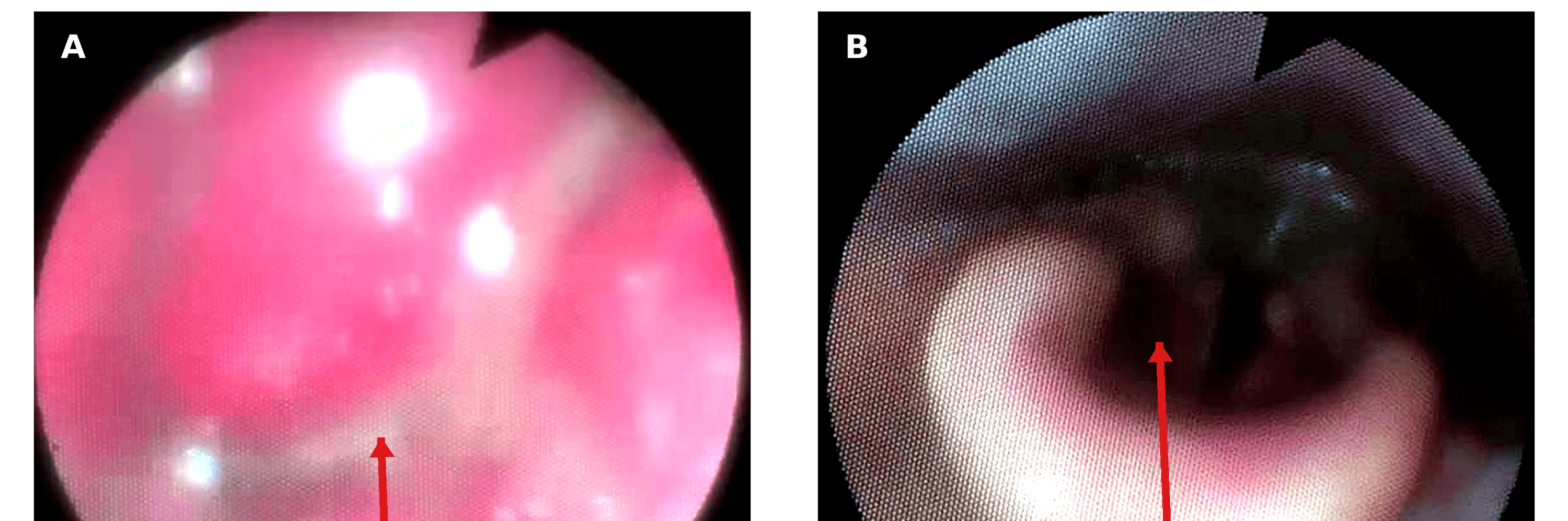
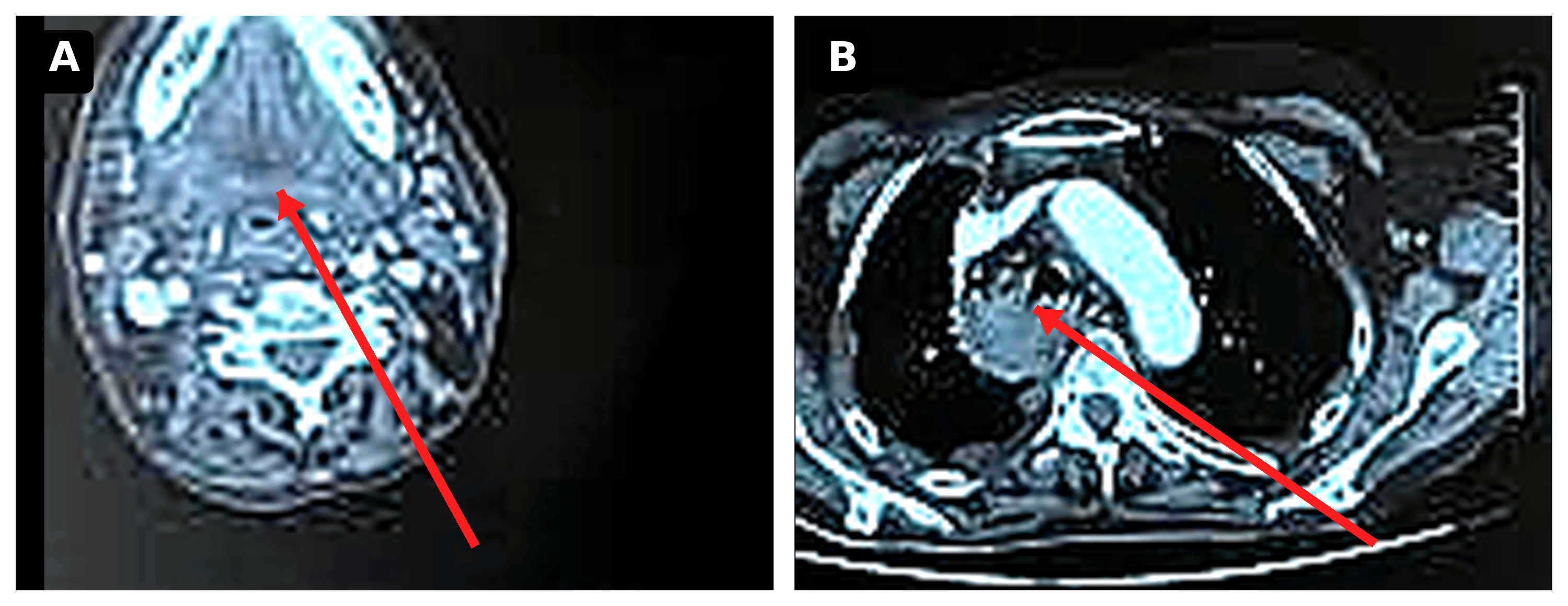
A 67-year-old woman presented to the emergency department with severe inspiratory dyspnea and signs of respiratory distress. Her medical history included treated hypertension, a cardiac rhythm disorder, and two previous ischemic strokes. Her long-term medication comprised rivaroxaban 20 mg/day, prescribed for cardioembolic prevention in this context, bisoprolol 1.25 mg twice daily, perindopril 4 mg each morning, and omeprazole 20 mg/day. There was no history of trauma, dental treatment, or recent surgery. Oral and cervical examination showed a diffuse ecchymotic hematoma of the floor of the mouth extending to the tongue base and anterior neck, accompanied by inspiratory stridor and respiratory exhaustion (Figure 1, Panel A). Urgent flexible nasofibroscopy demonstrated marked epiglottic and supraglottic edema, critical airway narrowing, and an inaccessible laryngeal inlet (Figure 2, Panel A). Orotracheal intubation was considered impossible; therefore, an immediate rescue tracheostomy was performed. Rivaroxaban was discontinued. Neither andexanet alfa nor four-factor prothrombin complex concentrate was available at our center in Morocco. After airway stabilization, cervicothoracic computed tomography (CT) demonstrated extensive hematoma involving the floor of the mouth and tongue base, with infiltration of the cervical soft tissues (Figure 3, Panel A), and a right retrotracheal mediastinal hematoma (Figure 3, Panel B). The patient was monitored in the intensive care unit for 48 hours. The hematoma and respiratory manifestations regressed rapidly, with marked improvement by day three (Figure 1, Panel B). Therapeutic enoxaparin 60 mg twice daily was initiated on day four without recurrent bleeding. Follow-up flexible nasofibroscopy on day five confirmed resolution of the epiglottic edema and restoration of a patent laryngeal inlet (Figure 2, Panel B). On day seven, the patient was successfully decannulated, the tracheostomy stoma was closed, and rivaroxaban 20 mg/day was resumed without early recurrence (Figure 1, Panel C).
Discussion
Rivaroxaban-associated upper-airway bleeding is exceptionally uncommon, and the published literature consists mainly of isolated case reports involving different anatomical compartments. Jalal Eldin et al. described a lingual hematoma in a 73-year-old man with end-stage renal disease who was receiving rivaroxaban; the patient improved with noninvasive medical treatment and did not require airway instrumentation [1]. Pelman et al. reported a spontaneous epiglottic hematoma treated with rivaroxaban reversal, corticosteroids, antibiotics, and close observation without intubation or tracheostomy [2]. By contrast, McCarter et al. described an atraumatic rivaroxaban-associated retropharyngeal hemorrhage extending toward the mediastinum [3], while Abukhder et al. reported a spontaneous retropharyngeal hematoma requiring fiberoptic nasotracheal intubation and intensive care monitoring [4]. Vierendeels et al. documented a retropharyngeal hematoma in a rivaroxaban-treated patient after bicycle trauma, illustrating the risk of airway obstruction but differing from our entirely spontaneous presentation [5]. Sasaki et al. similarly described floor-of-mouth and pharyngeal swelling after mandibular trauma in a patient receiving a direct oral anticoagulant [6]. Our case differs from these reports because the bleeding was spontaneous, centered on the floor of the mouth, extended to the cervical soft tissues and mediastinum, and caused advanced respiratory distress with an inaccessible laryngeal inlet. These features made rescue tracheostomy immediately necessary rather than elective.
Management of life-threatening factor Xa inhibitor bleeding requires simultaneous control of the immediate vital threat, discontinuation of anticoagulation, and consideration of reversal. Four-factor prothrombin complex concentrate has been used during severe rivaroxaban-associated oropharyngeal hemorrhage [7]. Andexanet alfa is a specific factor Xa inhibitor reversal agent with documented hemostatic efficacy [8]. Current guidance supports andexanet alfa or four-factor prothrombin complex concentrate according to the bleeding site, severity, timing of the last anticoagulant dose, and local availability [9,10]. Neither reversal option was available at our center at the time of treatment. This limitation increased the importance of immediate surgical airway control, anticoagulant withdrawal, and intensive monitoring. The rapid regression of the hematoma, successful decannulation on day seven, and absence of early recurrent bleeding after rivaroxaban resumption support the effectiveness of this airway-first strategy, although the favorable outcome of a single case cannot establish comparative efficacy.
Conclusions
A spontaneous floor-of-mouth hematoma associated with rivaroxaban may cause sudden, life-threatening upper-airway obstruction. When extensive hematoma and supraglottic edema make intubation impossible, immediate rescue tracheostomy is essential. Specific reversal should be considered when available, but it must never delay definitive airway control.
References
- Jalal Eldin A, Mukhtar N, Adane M, Newkirk C: Effective non-invasive treatment of lingual hematoma in an end-stage renal disease (ESRD) patient on rivaroxaban: a case report. Cureus. 2024, 16:e61581. 10.7759/cureus.61581
- Pelman A, Deere J, Schneider K, Van Heukelom J: Spontaneous epiglottic hematoma secondary to direct oral anticoagulant. Am J Emerg Med. 2022, 59:216.e7-9. 10.1016/j.ajem.2022.06.023
- McCarter JA, Bell PR, McCadden L, Scally C: Rivaroxaban and retropharyngeal haemorrhage. BMJ Case Rep. 2016, 2016:bcr2015212446. 10.1136/bcr-2015-212446
- Abukhder M, Hulme J, Nathoo S, Shubhi S: Spontaneous retropharyngeal haematoma with direct oral anticoagulant medication. BMJ Case Rep. 2021, 14:e240369. 10.1136/bcr-2020-240369
- Vierendeels C, Peeters X, Bosschaert P: Retropharyngeal hematoma under rivaroxaban: a rare entity to know for its risk of airway obstruction. J Belg Soc Radiol. 2021, 105:15. 10.5334/jbsr.2263
- Sasaki R, Okamoto T, Sangu NM, Kudo S, Ando T: Mandibular fracture in a patient taking a direct oral anticoagulant. J Craniofac Surg. 2021, 32:1421-2. 10.1097/SCS.0000000000007162
- White K, Gagnon Z, Cocchio C: Rapid administration of Kcentra® during cardiopulmonary arrest. Am J Emerg Med. 2023, 70:211.e1-3. 10.1016/j.ajem.2023.02.015
- Connolly SJ, Crowther M, Eikelboom JW, et al.: Full study report of andexanet alfa for bleeding associated with Factor Xa inhibitors. N Engl J Med. 2019, 380:1326-35. 10.1056/NEJMoa1814051
- Levy JH, Shaw JR, Castellucci LA, et al.: Reversal of direct oral anticoagulants: guidance from the SSC of the ISTH. J Thromb Haemost. 2024, 22:2889-99. 10.1016/j.jtha.2024.07.009
- Grottke O, Afshari A, Ahmed A, Arnaoutoglou E, Bolliger D, Fenger-Eriksen C, von Heymann C: Clinical guideline on reversal of direct oral anticoagulants in patients with life threatening bleeding. Eur J Anaesthesiol. 2024, 41:327-50.