

Summary:Perioperative care must evolve from reactive models toward predictive, personalized, and proactive paradigms. Leveraging technologies such as AI, wearable sensors, and closed‐loop systems, alongside a strong safety culture, could improve outcomes, reduce complications, reduce burden on clinicians, and better align care with patient needs.

AI-generated photo of a futuristic operating arena.
“If I had asked people what they wanted, they would have said faster horses.”
— Henry Ford
Henry Ford’s quote underscores the importance of transcending legacy systems and embracing innovative models of health care that align with the needs of our patients. The vision of APSF—that no one shall be harmed by anesthesia care—is a mandate shaped by the needs, values, and voices of our patients. Achieving this vision requires reimagining care—driven by emerging technologies that not only elevate outcomes but also embed safety into every moment of the patient journey.
We stand at the threshold of a perioperative renaissance, and we must rise above cognitive, implementation, and financial barriers to deliver truly predictive, personalized, and safer care. We should demand care that delivers improved outcomes for patients and impacts our workforce with an experience that sustains purpose and attracts the brightest minds to our field. The future will belong to those who embrace innovation as the foundation of safer care.
TECHNOLOGY AS THE FUTURE OF SAFER CARE
Consider Alex, a 75-year-old retiree, who underwent surgery for colon cancer. Prior to his surgery, Alex had a history of hypertension and diabetes, but was independent with no cognitive impairment. During the procedure, multiple episodes of modest hypotension occurred. On the night after surgery, Alex exhibited signs of postoperative delirium and fell while getting out of bed. The delirium worsened, prolonging the hospital stay. Alex never returned to independent living and was discharged to long-term care.
This story highlights the consequences of a reactive care model—where early signs of deterioration are often missed. With emerging technology, we can predict risk, intervene proactively, and change outcomes.
ARTIFICIAL INTELLIGENCE (AI)
The modern age of AI dates to the growth of digital health records and computational power which provide the foundation for machine learning, personalized medicine, and predictive analytics. Machine learning—a key branch of AI—develops learning algorithms which detect patterns that predict complications, identify appropriate therapies, and enable earlier intervention.
The perioperative environment is data-rich, relying heavily on the electronic medical record, physiological waveforms, and outputs from infusion and monitoring devices. The advancement of AI in perioperative medicine will likely focus on real-time signal processing, integration of multimodal physiologic data, and closed-loop interoperability between monitoring platforms and delivery systems. These technologies employ real-time decision support to drive earlier interventions and adapt signal processing to personalize therapy. Moreover, AI-enabled alarm management may reduce alarm fatigue by suppressing nonactionable alerts, enhancing safety, and mitigating the burden on a strained workforce.
Responsible AI should be viewed as a powerful complement to the human connection—enhancing complex decision-making and amplifying situational awareness. In the words of Karim Lakhani, “AI won’t replace humans— but humans with AI will replace humans without AI.”1
WEARABLES
Consumer-grade wearables have become widely adopted for personal health. In contrast, health care systems have been slow to integrate medical-grade wearables into clinical workflows due to performance requirements, regulatory thresholds, cost, and concern about the impact on strained caregivers.
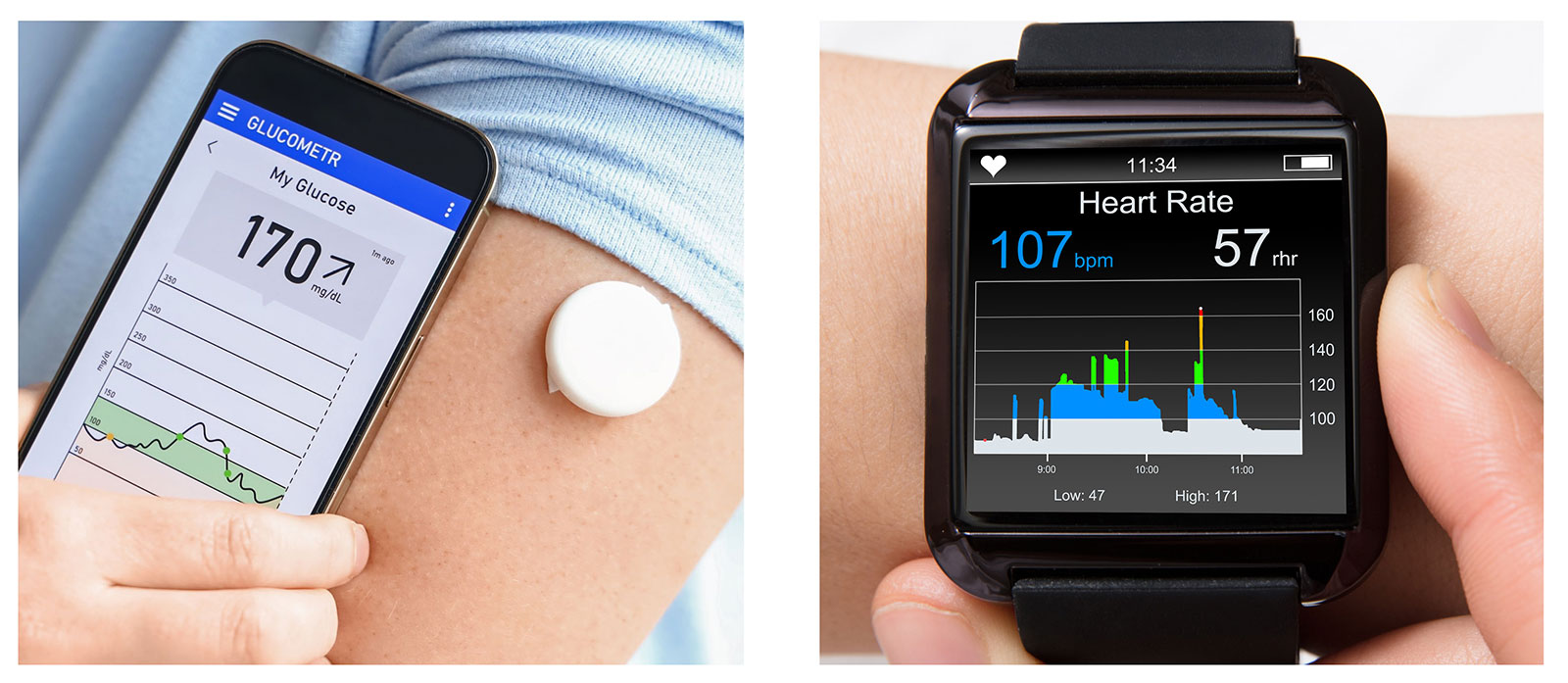
Consumer-grade wearables have become widely adopted for personal health.
Unfortunately, in the perioperative setting there are striking “monitoring deserts” where personalized, continuous data could greatly enhance personalized care. Examples include the preoperative period, where data could inform prehabilitation strategies; the postoperative floor, where monitoring is typically limited to intermittent checks; and the home, where monitoring is usually absent.
A unique challenge is the need to integrate wearable technologies with AI systems capable of transforming continuous streams of raw physiologic data into meaningful, actionable insights. One promising solution is the development of a digital twin—a real-time, data-driven virtual model of a patient’s biologic and physiologic status. Informed by wearable sensors and linked to AI, this dynamic model could enable earlier and more precise interventions, shifting health care from a reactive, one-size-fits-all approach to one that is proactive, personalized, and predictive. For example, a postsurgical patient equipped with a biosensor might transmit multiple physiologic parameters to a centralized AI-supported monitoring platform. The AI system could identify early signs of respiratory depression and trigger an alert, guiding timely clinical intervention before a critical event occurs.
CLOSED LOOP SYSTEMS
Workstations of the future will employ closed-loop systems that will be extenders of care by automating simple, repetitive tasks. A closed-loop system uses data from an input (e.g., the electroencephalogram), which is fed to a controller (computer algorithm), which adjusts the output (e.g., propofol dose) to maintain the patient within an optimal zone, thus, reducing variation. In theory, spending more time in the optimal zone should reduce the risk of complications and offload repetitive tasks from the clinician and allow them to spend more time on situational awareness and total patient care. The ideal system would integrate several closed-loop systems into a master controller as opposed to three independent systems (i.e., hypnosis, fluid therapy, and hemodynamic management).
THE CRITICAL IMPORTANCE OF SAFETY CULTURE
Safety culture reflects “the sum of what an organization is and does in the pursuit of safety.”2 This definition acknowledges that safety cultures differ across organizations. Maya Angelou famously said, “People may forget what you said, but they will never forget how you made them feel.” This powerful reminder underscores the essential role of culture, high-functioning teams, and the healing power of the human connection. At its core, the human touch fosters trust, improves outcomes, and reaffirms the purpose of our work.
Health care systems face a challenging environment, and efforts to strengthen safety culture are too often subservient to immediate operational needs. While this may seem pragmatic, the long-term costs are substantial. When we fail to embed safety into every moment of care, we compromise the mission of health care and erode public trust. It is therefore imperative to advocate for investment in systems, training, and technologies that embed safety as foundational.

AI-generated image of doctor consulting AI with patient.
CONCLUSION
The future of perioperative safety must transcend the boundaries of today’s systems. Grounded in our enduring vision, we have an opportunity to reshape the arc of patient outcomes. Artificial intelligence, decision support, wearable technologies, and closed-loop systems are catalysts for a new model of care and high-value solutions to promote safety culture. They change health care from a reactive system to a predictive, personalized, and proactive system. Importantly, they reduce cognitive burden, enhance professional fulfillment, and attract the brightest minds to our specialty. The next era of perioperative safety is within reach. And if we choose to lead with vision, courage, and purpose, we can rewrite the story of Alex.
REFERENCES
- Harvard Business Review. AI won’t replace humans but humans with AI will replace humans without AI. August 4, 2023. Available at: https://hbr.org/2023/08/ai-wont-replace-humans-but-humans-with-ai-will-replace-humans-without-ai. Accessed June 30, 2025.
- Joint Commission. 11 tenets of a safety culture. Available at: https://www.jointcommission.org/-/media/tjc/documents/resources/patient-safety-topics/ sentinel-event/sentinel_events_11_tenets_of_a_safety_ culture_ infographic_ 2018.pdf. Accessed June 30, 2025.