

Madkhali M M, Safhi A Y, Khormi N A, et al. (May 06, 2026) Sevoflurane Versus Propofol for Postoperative Sedation After Cardiac Surgery: A Systematic Review of Randomized Controlled Trials. Cureus 18(5): e108341. doi:10.7759/cureus.108341
Abstract
Optimal postoperative sedation after cardiac surgery remains debated. Sevoflurane delivered via anesthetic conserving devices has emerged as an alternative to intravenous (IV) propofol, but its comparative effectiveness and safety in the intensive care unit (ICU) remain uncertain. This systematic review and meta-analysis evaluated the efficacy and safety of sevoflurane versus propofol for postoperative ICU sedation after cardiac surgery.
We conducted the review in accordance with Preferred Reporting Items for Systematic Reviews and Meta-Analyses (PRISMA) guidelines and the Cochrane Handbook. Medline, Web of Science, Scopus, and CENTRAL were searched without date restrictions. Randomized controlled trials (RCTs) comparing inhaled sevoflurane with IV propofol in mechanically ventilated adult patients admitted to the ICU after cardiac surgery were included. Primary outcomes were time to extubation, ICU length of stay (LOS), and hospital LOS. Secondary outcomes included acute renal failure (ARF), atrial fibrillation, mortality, and postoperative nausea and vomiting (PONV).
Eight RCTs involving 688 patients were included. Four studies reporting time to extubation showed no significant difference between groups overall (mean difference (MD) -62.67, 95% confidence interval (CI) -157.23 to 31.90; p = 0.2977), with high heterogeneity (I² = 91.7%). Sensitivity analysis excluding one study showed significantly shorter extubation time with sevoflurane (MD −72.51, 95% CI -135.83 to -9.20; p = 0.0388). No significant differences were observed for ICU LOS (MD -0.29, 95% CI -4.10 to 3.51) or hospital LOS (MD -0.40, 95% CI -2.67 to 1.63). Secondary outcomes, including mortality, ARF, atrial fibrillation, and PONV, were also comparable between groups.
Sevoflurane appears comparable to propofol for postoperative sedation after cardiac surgery and may reduce time to extubation in selected analyses; however, the evidence remains limited by heterogeneity and possible publication bias.
Introduction & Background
Analgesics and sedatives are routinely administered to patients in the intensive care unit (ICU) after cardiac surgery to improve tolerance of mechanical ventilation and to manage pain and anxiety [1-4]. However, prolonged sedation is associated with extended ICU stays and increased risks of delirium, mortality, and postoperative cognitive dysfunction [2,3]. These risks may be reduced by promoting earlier and more predictable awakening, allowing for frequent and reliable neurological assessments.
Commonly used ICU sedatives include intravenous (IV) benzodiazepines, such as midazolam and lorazepam, and propofol, often combined with opioids or dexmedetomidine [1,5]. These agents are frequently associated with adverse effects, including oversedation, prolonged mechanical ventilation, and hypotension, which can contribute to longer ICU stays [6-8]. In addition, their metabolism and clearance depend on adequate hepatic and renal function, posing challenges in older cardiac surgery patients, who have a higher prevalence of organ dysfunction. Propofol remains widely used due to its rapid onset, short duration of action, and effectiveness in achieving deep sedation [3,5].
Inhalational anesthetics have emerged as an alternative for sedation in mechanically ventilated ICU patients. Volatile agents such as sevoflurane, desflurane, and isoflurane have favorable pharmacokinetic profiles and may facilitate faster awakening, improved neurological recovery, and shorter time to extubation [6,8]. They may also confer cardioprotective effects through mechanisms such as ischemic preconditioning and postconditioning, which can reduce myocardial ischemia-reperfusion injury.
Sevoflurane, a halogenated inhalational anesthetic, offers advantages over other volatile agents, including rapid onset and clearance and a lower incidence of adverse effects [2,5]. When administered using an Anaesthetic Conserving Device (AnaConDa), it provides a practical option for ICU sedation. It has been proposed as an alternative to IV propofol for short-term sedation after cardiac procedures such as coronary artery bypass grafting (CABG). This study aims to evaluate the efficacy and safety of sevoflurane compared with propofol for postoperative ICU sedation in patients undergoing cardiac surgery.
Review
Methods
Study Design and Reporting
This systematic review and meta-analysis was conducted in accordance with the Preferred Reporting Items for Systematic Reviews and Meta-Analyses (PRISMA) guidelines [9].
Literature Search Strategy
A comprehensive search was performed across four electronic databases: Medline, Web of Science (WOS), Scopus, and the Cochrane Central Register of Controlled Trials (CENTRAL). The search included the keywords “sevoflurane,” “propofol,” and “cardiac surgery,” with no restrictions on publication date. Duplicates were removed using EndNote software. Forward and backward citation screening of included studies and relevant reviews was conducted to identify additional eligible studies.
Eligibility Criteria and Study Selection
Studies were selected based on the Population, Intervention, Comparator, and Outcome (PICO) framework [10]. The population included critically ill adult patients (≥18 years) admitted to the ICU after cardiac surgery, including CABG, valve procedures, off-pump surgery, or combined procedures, who required mechanical ventilation and sedation.
The intervention was inhaled sevoflurane administered via an AnaConDa or Mirus reflector, with any sedation duration or target depth measured by validated scales such as the bispectral index (BIS) or Richmond Agitation-Sedation Scale (RASS) [11]. The comparator was IV propofol, administered as a continuous infusion, with or without adjunct analgesia. Only randomized controlled trials (RCTs) were included.
Data Extraction
Two reviewers independently extracted data using a standardized spreadsheet. Extracted data included study characteristics (e.g., country, design, type of surgery, sedation protocol), baseline patient characteristics (e.g., age, sex, body mass index (BMI), comorbidities, operative variables), and outcomes.
Primary outcomes were time to extubation, ICU length of stay (LOS), and hospital LOS. Secondary outcomes included acute renal failure (ARF), atrial fibrillation or arrhythmia, mortality, and postoperative nausea and vomiting (PONV).
Quality Assessment
The risk of bias of included studies was independently assessed by two reviewers using the Cochrane Risk of Bias 2 (ROB2) tool [12], with disagreements resolved by a third reviewer. The assessment covered randomization, deviations from intended interventions, missing outcome data, outcome measurement, and selective reporting. Each domain was rated as low risk, some concerns, or high risk of bias.
Statistical Analysis
Statistical analysis was performed using R software (version 4.4; R Foundation for Statistical Computing, Vienna, Austria). Mean differences (MDs) were calculated for continuous outcomes and odds ratios (ORs) for dichotomous outcomes, each with 95% confidence intervals (CIs). Statistical significance was set at p < 0.05.
Heterogeneity was assessed using the I² statistic and corresponding p-values, with I² < 40% considered low, 40%-60% moderate, and > 60% high heterogeneity. Sensitivity analyses and Galbraith plots were used to explore heterogeneity and assess robustness. Subgroup analyses were conducted for primary outcomes based on the type of surgery.
Results
Literature Search Results
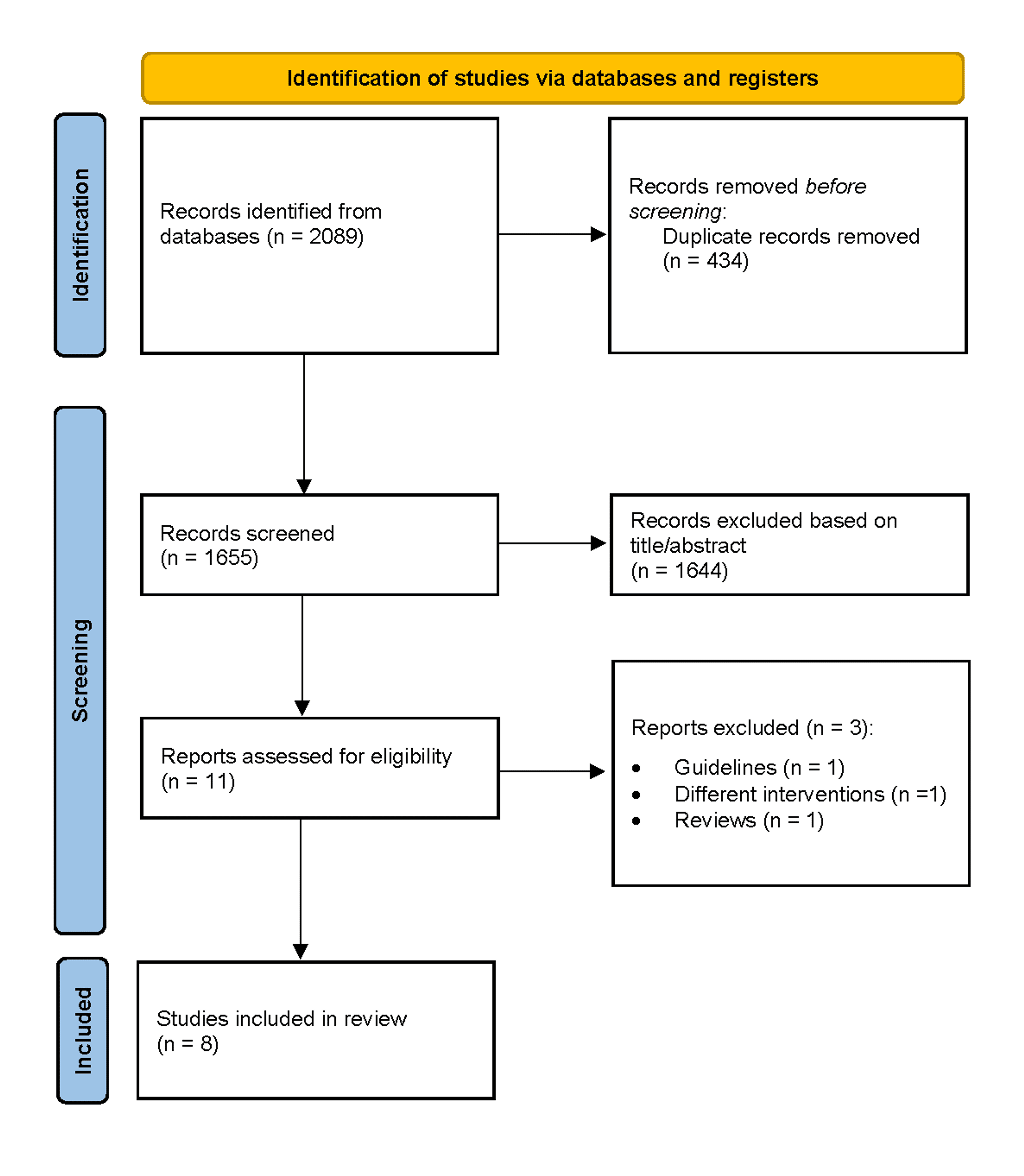
The database search identified 2,098 records, of which 1,655 remained after duplicate removal. Following title, abstract, and full-text screening, eight RCTs [1-8] were included in the meta-analysis (Figure 1).
Study Characteristics and Quality Assessment
Eight RCTs [1-8], published between 2008 and 2024 and including a total of 688 patients, compared sevoflurane with propofol for postoperative sedation after cardiac surgery. The studies were conducted in Germany, Spain, France, Sweden, and Switzerland and included procedures such as CABG and other open cardiac surgeries. The mean age of participants was 65.2 years, and 68.4% were male. Risk of bias assessment using the Cochrane Risk of Bias 2 (ROB2) tool showed that two studies [2,6] had low risk, five studies [1,3,5,7,8] had some concerns, and one study [4] had high risk of bias (Tables 1–3).
Primary Outcomes
Four studies (n = 344) [1,2,4,6] reported time to extubation. There was no significant difference between sevoflurane and propofol (MD -62.67, 95% CI -157.23 to 31.90; p = 0.2977), with high heterogeneity (I² = 91.7%). Sensitivity analysis, excluding one study [4], resulted in a significant reduction in extubation time favoring sevoflurane (MD -72.51, 95% CI -135.83 to -9.20; p = 0.0388), with moderate heterogeneity (I² = 54.8%). Subgroup analysis suggested a benefit of sevoflurane in mixed and valve surgery populations [2,6], while no significant difference was observed in isolated CABG patients [1,4].
Five studies (n = 452) [1,2,3,5,7] reported ICU LOS. No significant difference was found between groups (MD -0.29, 95% CI -4.10 to 3.51), with low heterogeneity (I² = 27.1%). Sensitivity and subgroup analyses did not change these results.
Four studies (n = 323) [2,3,6,8] reported hospital LOS. There was no significant difference between sevoflurane and propofol (MD -0.75, 95% CI -3.13 to 1.63), with low heterogeneity (I² = 35.8%). Sensitivity and subgroup analyses confirmed result stability.
Secondary Outcomes
No significant differences were observed between groups for any secondary outcomes. Four studies [1,3,5,7] reported mortality, showing an OR of 2.50 (95% CI 0.77 to 8.19), with no heterogeneity (I² = 0%). Three studies [2,4,6] reported ARF, showing an OR of 0.95 (95% CI 0.15 to 6.10), with moderate heterogeneity (I² = 48.7%). Three studies [1,6,8] reported PONV, showing an OR of 0.84 (95% CI 0.24 to 2.90), with low heterogeneity (I² = 24.4%). Three studies [2,3,5] reported atrial fibrillation, showing an OR of 1.09 (95% CI 0.41 to 2.88), with no heterogeneity (I² = 0%).
Summary of Findings
The main outcomes are summarized in Table 4. No significant differences were observed between sevoflurane and propofol for ICU or hospital LOS. Time to extubation showed no overall difference; however, sensitivity analysis suggested a shorter extubation time with sevoflurane. Secondary outcomes, including mortality, ARF, atrial fibrillation, and PONV, were comparable between groups.
Limitations
This study has several limitations. The number of included RCTs was small, with limited sample sizes for key outcomes such as mortality, ARF, and atrial fibrillation. Substantial clinical heterogeneity was present across studies, including differences in surgical procedures, cardiopulmonary bypass exposure, sedation protocols, extubation criteria, and delivery devices. Evidence of potential publication bias and the sensitivity of results to study exclusion further reduces the certainty of the findings. Overall, larger and more standardized trials are needed to confirm these results.
Conclusions
Sevoflurane may serve as a recovery-enhancing sedative that can shorten the time to extubation after cardiac surgery. However, this potential benefit does not appear to translate into consistent improvements in ICU or hospital LOS or in postoperative complication rates. Overall, sevoflurane represents a reasonable alternative to propofol in selected settings, but it cannot be considered a clearly superior standard approach. Further well-designed, large-scale studies are needed to clarify its clinical impact.