

Authors: Buckholz M, Moradian A, Patel R M, et al.
Cureus 18(7): e112926. doi:10.7759/cureus.112926
Abstract
Effective postoperative pain management following orthopedic surgery remains a challenge, particularly in the context of increasing opioid-related morbidity. Multimodal analgesic strategies incorporate adjuvant therapies such as ketamine to reduce opioid requirements while maintaining adequate pain control. This systematic review evaluated the efficacy and safety of perioperative ketamine as an adjunct to opioid therapy for acute postoperative pain management in adults undergoing orthopedic procedures. A PRISMA-guided search of Ovid MEDLINE, Embase, Web of Science, and Cochrane CENTRAL identified randomized controlled trials published between January 2014 and September 2024. Eligible studies included patients aged 18-65 years undergoing orthopedic surgery who received perioperative ketamine compared to opioid-based regimens. Primary outcomes included postoperative opioid consumption and patient-reported pain scores, while secondary outcomes included adverse events. Risk of bias was assessed using the Joanna Briggs Institute (JBI) Critical Appraisal Checklist for Randomized Controlled Trials. Due to heterogeneity in ketamine dosing, administration, and outcome reporting, a qualitative synthesis was performed. Eleven randomized controlled trials met the inclusion criteria. Adjunctive ketamine reduced postoperative opioid consumption in five of 11 studies, with the most consistent effects observed within the first 24 hours postoperatively. Four studies reported statistically significant improvements in patient-reported pain scores, while others demonstrated no significant differences despite reduced opioid use. Ketamine showed a safety profile comparable to opioid-only regimens, with no consistent increase in adverse events; several studies reported reductions in opioid-related side effects such as pruritus and sedation. Perioperative ketamine may reduce postoperative opioid consumption without increasing adverse events, although its effect on pain intensity remains variable. These findings support its use as part of multimodal analgesia strategies aimed at minimizing opioid exposure, though further research is needed to standardize dosing protocols and evaluate long-term outcomes.
Introduction & Background
Orthopedic surgical procedures are increasingly common in the United States owing to an aging population, the rising prevalence of obesity, and continued advancements in surgical techniques [1,2]. Musculoskeletal conditions account for a substantial proportion of healthcare utilization, representing a leading cause of outpatient visits nationwide [3]. Among these conditions, osteoarthritis and other degenerative joint diseases contribute significantly to surgical demand and associated healthcare burden.
Total hip and knee arthroplasty are well-established and effective interventions for patients with advanced osteoarthritis who have failed conservative management [4]. According to the Healthcare Cost and Utilization Project (HCUP), orthopedic procedures – including knee and hip arthroplasty, spinal fusion, femur fixation, and vertebral discectomy – rank among the most frequently performed inpatient surgeries in the United States [5]. These procedures require a comprehensive perioperative approach, with effective postoperative pain management playing a critical role in optimizing recovery and functional outcomes.
Opioids remain a cornerstone of postoperative analgesia for moderate to severe pain. These agents exert their effects primarily through μ-opioid receptor agonism, inhibiting nociceptive transmission at both spinal and supraspinal levels [6]. Although effective, opioid use is associated with well-documented adverse effects, including central nervous system depression, respiratory depression, nausea, vomiting, constipation, pruritus, and potential endocrine dysfunction [6]. Commonly used perioperative opioids include fentanyl, morphine, hydromorphone, oxycodone, and tramadol, selected based on pharmacokinetic properties, potency, and route of administration [7]. In response to growing concerns regarding opioid-related morbidity, dependence, and misuse, perioperative pain management strategies have shifted toward opioid-sparing, multimodal approaches. Current multidisciplinary guidelines emphasize minimizing opioid exposure while maintaining adequate analgesia through the use of non-opioid adjuncts [8].
Ketamine, an N-methyl-D-aspartate (NMDA) receptor antagonist, possesses both anesthetic and analgesic properties and has emerged as a potential adjunct in multimodal analgesia regimens [9]. In addition, it exhibits anti-hyperalgesic properties by attenuating central sensitization and reducing nociceptive amplification, thereby helping prevent postoperative pain hypersensitivity while decreasing opioid requirements. Prior studies have demonstrated reductions in postoperative opioid consumption and, in some cases, improvements in pain scores among orthopedic surgical populations receiving perioperative ketamine [10]. Additionally, ketamine has been associated with a reduction in opioid-related adverse events, such as postoperative nausea and vomiting, compared to opioid monotherapy [11].
Effective control of acute postoperative pain is essential for facilitating early mobilization, improving patient satisfaction, and enhancing recovery trajectories following orthopedic surgery [12-14]. Multimodal analgesia strategies combining opioids with adjuvant agents have, therefore, become standard practice, replacing traditional opioid-centric approaches [8,12-14]. These principles are consistent with Enhanced Recovery After Surgery (ERAS) protocols, which emphasize multimodal, opioid-sparing analgesia to facilitate early mobilization and reduce opioid-related complications following orthopedic procedures. Within ERAS pathways, ketamine is recognized as a valuable adjunct because of its opioid-sparing properties and its ability to support effective multimodal analgesia in appropriately selected patients. Accordingly, ketamine represents a promising adjunct that may reduce opioid exposure, improve functional recovery, and mitigate adverse effects associated with higher opioid doses. However, despite increasing clinical adoption, uncertainty remains regarding the consistency of its analgesic benefit and overall safety profile in orthopedic surgical populations.
The ongoing opioid epidemic further underscores the importance of optimizing perioperative prescribing practices. Exposure to opioids in the postoperative setting has been identified as a potential pathway to long-term use and, in some cases, transition to misuse or illicit opioid consumption [15,16]. Consequently, identifying effective opioid-sparing strategies is a critical priority in perioperative care.
Previous systematic reviews and meta-analyses have reported that perioperative ketamine may reduce postoperative opioid consumption, although its effects on pain intensity have been inconsistent [10,11]. However, many earlier reviews included heterogeneous surgical populations or studies published before more recent randomized controlled trials became available [10,11]. The present review provides an updated synthesis focused specifically on contemporary controlled trials evaluating perioperative ketamine in adult orthopedic surgical populations.
This systematic review aims to evaluate the efficacy and safety of perioperative ketamine as an adjunct to opioid therapy for acute postoperative pain management in adults undergoing orthopedic surgery. It is hypothesized that ketamine use will be associated with reduced opioid consumption, improved pain control, and a lower incidence of adverse events compared to opioid monotherapy.
Review
Methods
The objective of this review was to evaluate the efficacy and safety profile of perioperative ketamine as an adjunct to traditional opioid monotherapy for acute postoperative pain management in patients aged 18-65 years undergoing orthopedic procedures.
Protocol and Registration
This systematic review was conducted in accordance with PRISMA guidelines [17]. The review was not prospectively registered (e.g., PROSPERO).
Eligibility Criteria
Eligible studies included randomized controlled trials, controlled clinical trials, and case-controlled trials evaluating perioperative ketamine administered either alone or as an adjunct to opioids for postoperative analgesia in adults aged 18-65 years undergoing orthopedic or spinal procedures. The age restriction was applied to reduce clinical heterogeneity because older adults often have substantially different perioperative pharmacokinetics, comorbidity profiles, and analgesic requirements, which may influence both analgesic efficacy and adverse event profiles. Consequently, the findings of this review may not be generalizable to elderly orthopedic populations. Studies published between January 2014 and September 2024 were considered. Interventions included ketamine administered via any route and at any perioperative time point. These were compared against opioid-based analgesic regimens without ketamine.
Studies were excluded if they evaluated non-standard adjunctive interventions (e.g., experimental behavioral therapies or non-pharmacologic modalities) that could confound analgesic outcomes. Standard-of-care measures such as NSAIDs, acetaminophen, and early ambulation were permitted. Outcomes of interest included postoperative opioid consumption and patient-reported pain scores such as the Visual Analog Scale (VAS), the Numeric Rating Scale (NRS), and adverse events [18,19]. Studies reporting outcomes beyond three months postoperatively were excluded. Only English-language publications were included.
Search Strategy
A comprehensive literature search was conducted in Embase, Ovid MEDLINE, Web of Science, and the Cochrane Central Register of Controlled Trials (CENTRAL). The databases were last searched on September 29, 2024. Grey literature sources were not searched.
The full search strategy was adapted for each database using a combination of MeSH terms and keywords. Tables 1–4 report the Embase, Ovid Medline, Web of Science, and Cochrane Central Register of Controlled Trials (CENTRAL) search strategies.
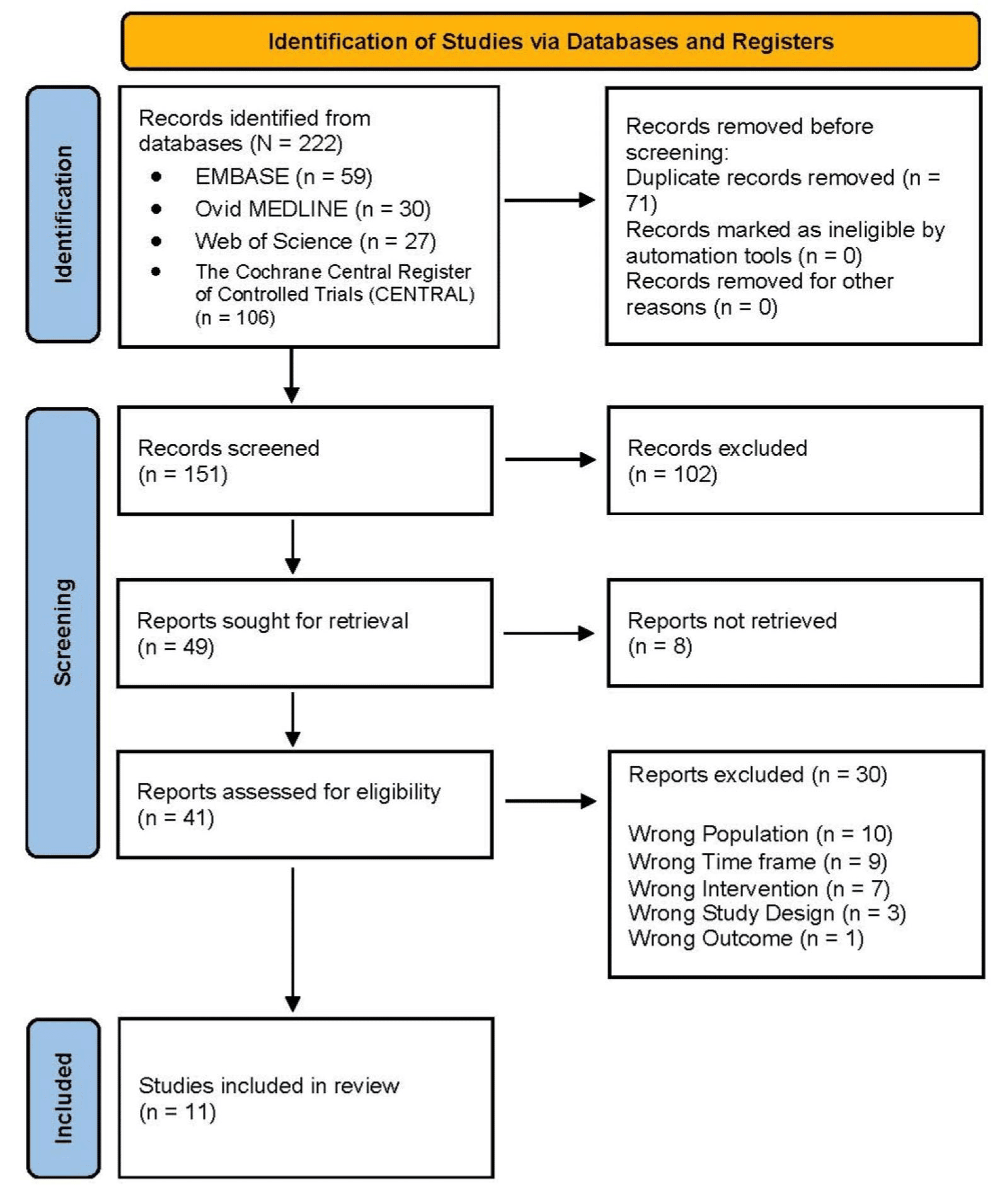
The words contained in the titles, abstracts, and keywords of relevant articles were used to conduct the full search. Only studies published in the English language were included due to the researcher’s language limitations. The databases yielded 222 articles, of which 71 were duplicates, leaving 151 records for screening. Two researchers independently screened the titles and abstracts using criteria based on the Population, Intervention, Comparison, and Outcome (PICO) framework to classify studies as “included” or “excluded.” This process resulted in the exclusion of 102 records, leaving 49 articles for full-text review. Of these, eight reports could not be retrieved, resulting in 41 full-text articles assessed for eligibility. Following a detailed review, 30 studies were excluded for the following reasons: wrong population (n = 10), wrong time frame (n = 9), wrong intervention (n = 7), wrong study design (n = 3), and wrong outcome (n = 1). Ultimately, 11 studies met the inclusion criteria. Figure 1 illustrates the study selection process.
Data Extraction
A standardized data extraction form was developed to collect study characteristics, including year, country, study design, sample size, intervention details, outcomes, adverse events, and limitations. Two reviewers independently extracted data, with disagreements resolved by consensus or third-party adjudication. Because of the limited number of included studies and substantial clinical heterogeneity in ketamine dosing, route and timing of administration, orthopedic procedures, and outcome reporting, formal subgroup analyses were not feasible. However, qualitative comparisons based on ketamine dose, route of administration, and timing of administration were incorporated into the narrative synthesis to explore potential sources of variability in treatment effects.
Critical Appraisal of Evidence
The included studies (N = 11) were assessed as having a low risk of bias based on the Joanna Briggs Institute (JBI) critical appraisal tools [20]. Most randomized controlled trials demonstrated appropriate randomization methods and allocation concealment, although reporting of these methods was inconsistent across studies. Blinding of participants and investigators was generally adequate but not uniformly described, introducing potential performance and detection bias in some cases. Variability in outcome measurement, including differences in pain scales and timing of assessment, introduced potential measurement bias. Selective reporting could not be fully excluded, as not all studies reported all predefined outcomes. Despite these limitations, the overall methodological quality of the included studies was acceptable, supporting the validity of the findings while highlighting the need for more standardized reporting in future research. Table 5 summarizes the study-level risk-of-bias assessment for each included trial and demonstrates that overall methodological quality was acceptable, with most concerns related to incomplete reporting of allocation concealment and variability in outcome assessment.
Results
Characteristics of the Studies
To facilitate comparisons across studies, the included studies were grouped in a table organized by study design, year of publication, methods, and purpose. The articles were then analyzed for outcomes and key findings, adverse events, and limitations. Eleven studies met the inclusion criteria, including predominantly randomized controlled trials along with controlled clinical trials.
The included studies consisted primarily of randomized controlled trials evaluating perioperative ketamine use in adult patients undergoing various orthopedic procedures, including spinal fusion, total knee arthroplasty, total hip arthroplasty, and arthroscopic repairs [21-31]. Variability was observed across studies in ketamine dosing, timing, and route of administration, as well as in outcome reporting.
Findings are presented across three domains: postoperative opioid consumption, pain intensity, and adverse events. Of the 11 included studies, five demonstrated statistically significant reductions in postoperative opioid consumption with adjunctive ketamine, while four reported statistically significant improvements in patient-reported pain scores. Across all studies, no significant increase in adverse events was observed, with several reporting reductions in opioid-related side effects.
Postoperative Opioid Consumption
Across the included studies, perioperative ketamine administration was frequently associated with reduced postoperative opioid consumption. Many studies demonstrated a statistically significant reduction in opioid requirements in patients receiving ketamine compared to opioid-only regimens.
Several randomized controlled trials reported notable reductions in opioid use within the first 24 hours postoperatively. Cengiz et al. demonstrated significantly lower cumulative morphine consumption in the ketamine group compared to placebo (47.0 mg versus 85.2 mg, p<0.001) [23]. Comparable findings were observed across multiple studies, demonstrating reductions in opioid requirements across different orthopedic procedures and postoperative time points [22-25,27,28,31]. Nielsen et al. reported reduced 24-hour morphine consumption following lumbar fusion surgery in patients receiving ketamine compared to the placebo group (79 vs 121 mg, p<0.001).
One study also demonstrated a statistically significant reduction in non-opioid analgesic requirements (diclofenac) and delayed time to first analgesic request, although this did not specifically reflect opioid consumption [24].
The extent of reduction varied across studies but demonstrated a frequent trend favoring ketamine use. Intravenous administration, particularly when initiated at induction and continued intraoperatively, was associated with the most pronounced reductions in opioid consumption. Across studies demonstrating benefit, postoperative opioid consumption was reduced by approximately 25% to 45% during the first 24 postoperative hours, although the magnitude varied according to ketamine dose, route of administration, surgical procedure, and comparator regimen. For example, Cengiz et al. reported a 45% reduction in cumulative morphine consumption (47.0 mg vs 85.2 mg), while Nielsen et al. reported an approximately 35% reduction following lumbar fusion surgery (79 mg vs 121 mg).
Patient-Reported Pain Intensity
Patient-reported pain outcomes, assessed using the NRS and VAS [18,19], were heterogeneous across studies. Three studies reported statistically significant reductions in postoperative pain scores with ketamine use. Cengiz et al. demonstrated significantly lower VAS scores at 24 hours in the ketamine group compared to placebo (2 vs 6.3 mm, p<0.001) [23]. Sharma et al. observed significantly lower NRS scores in patients receiving ketamine, particularly when administered preemptively at induction [31]. One study reported a statistically significant reduction in pain scores in the highest-dose ketamine group, suggesting a dose-dependent effect [22]. However, other studies reported no significant differences in pain scores between ketamine and control groups despite reductions in opioid consumption [21,26-28,30]. Paulin [29] also found no significant difference, but that study focused more broadly on recovery and satisfaction rather than just pain, so leaving it out is reasonable. Jelodar et al. demonstrated statistically significant improvements in postoperative pain scores with both ketamine and dexmedetomidine as adjuncts to morphine compared to morphine alone; however, dexmedetomidine was associated with greater pain reduction than ketamine [25].
Overall, while ketamine as an adjunct suggested a potential improvement in pain control, findings were inconsistent, with only a subset of studies demonstrating statistically significant improvements. Reductions in opioid consumption were not uniformly accompanied by significant improvements in patient-reported pain intensity.
Adverse Events
Across the included studies, perioperative ketamine demonstrated a safety profile comparable to opioid-only regimens. No consistent increase in adverse events was observed with ketamine use. Common postoperative adverse events, including nausea, hallucinations, and nightmares, were reported at similar rates between ketamine and control groups, with no statistically significant differences in most studies. Notably, concerns regarding ketamine-associated psychomimetic effects were not substantiated by consistent findings across the included literature.
Three studies reported reductions in opioid-related adverse effects in the ketamine groups. For example, decreased incidence of pruritus and lower levels of postoperative sedation were observed in select studies [24,27]. However, these findings were not consistently replicated across all studies. Table 6 reports on the characteristics of the included studies.
To facilitate comparison across studies, Table 7 summarizes ketamine administration strategies and their associated clinical outcomes.
Discussion
The most consistent finding across the included studies was a reduction in postoperative opioid requirements, particularly during the first 24 hours following surgery [22-24,27,28,31]. Although the magnitude of benefit varied, these findings suggest that perioperative ketamine may serve as an effective opioid-sparing adjunct across a range of orthopedic procedures. Studies employing intravenous ketamine initiated before surgical incision and continued intraoperatively generally demonstrated the most favorable outcomes [23,27-29,31], consistent with ketamine’s antagonism of the N-methyl-D-aspartate (NMDA) receptor and its ability to attenuate central sensitization [9].
In contrast, improvements in patient-reported pain intensity were less consistent. Although several studies demonstrated statistically significant reductions in postoperative pain scores [22,23,25,31], others found no significant differences despite reductions in opioid consumption [21,26-28,30]. This discordance likely reflects heterogeneity in study design, ketamine dosing regimens, timing and route of administration, and pain assessment methods, including whether pain was assessed at rest or during movement and during the early or later postoperative period. These differences in outcome assessment may have contributed to the variability in reported analgesic efficacy across studies. It also suggests that reduced opioid consumption does not necessarily translate into measurable improvements in pain scores, particularly when baseline multimodal analgesia already provides adequate pain control.
Route and timing of ketamine administration also appeared to influence treatment response. Intravenous administration initiated before incision and continued throughout surgery produced the most consistent opioid-sparing effects and, in some studies, improved postoperative analgesia [23,27-29,31]. In contrast, studies evaluating epidural, intra-articular, or postoperative ketamine administration generally reported less consistent clinical benefit [24,26,30]. These findings further support the concept that ketamine is most effective when administered as a preemptive analgesic to reduce central sensitization before and during surgical tissue injury [9]. However, this observation represents an overall qualitative interpretation of the included studies rather than a predefined subgroup analysis and should therefore be interpreted cautiously.
Across the included studies, perioperative ketamine demonstrated a favorable safety profile. No consistent increase in adverse events was observed compared with opioid-only regimens [11,22,27,28]. Furthermore, several investigations reported reductions in opioid-related adverse effects, including pruritus and postoperative sedation [22,24,27,28], suggesting that ketamine’s opioid-sparing effects may provide indirect safety benefits. Although isolated reports described increased sedation with higher ketamine doses, these findings were not consistently replicated.
Collectively, these findings support the incorporation of ketamine into multimodal analgesia protocols designed to reduce perioperative opioid exposure [8,10-12]. Such an approach may be particularly valuable for patients at increased risk for opioid-related complications or prolonged postoperative opioid use. However, because improvements in pain intensity were less consistent than reductions in opioid consumption, ketamine should be viewed primarily as an opioid-sparing adjunct rather than as a replacement for conventional postoperative analgesic strategies.
Limitations
This review is limited by significant heterogeneity across studies in ketamine dosing, timing, route of administration, and outcome reporting, which restricted direct comparison and precluded meta-analysis. The relatively small number of studies included and variation in study design may limit generalizability. Additionally, restriction to English-language publications introduces potential selection bias. Furthermore, because gray literature was not searched, publication bias cannot be excluded, as unpublished studies with neutral or negative findings may not have been identified. Variability in pain assessment methods and timepoints further complicates interpretation of analgesic outcomes. Because only randomized and controlled clinical trials were included, potentially informative observational studies were excluded.
The findings of this review are generally consistent with previous systematic reviews and meta-analyses demonstrating that perioperative ketamine provides a reliable opioid-sparing effect while producing less consistent improvements in postoperative pain intensity [10,11]. By focusing on contemporary randomized controlled trials in orthopedic surgery, the present review further highlights how ketamine dose, route, and timing of administration may contribute to variability in clinical outcomes.
Future Research
Future research should focus on standardizing ketamine administration protocols, including optimal dosing, timing, and route of delivery. Future investigations should also examine patient-centered outcomes, including functional recovery, quality of recovery, length of hospital stay, and persistent postoperative opioid use. Comparative studies evaluating different ketamine formulations and administration strategies are needed to clarify its role in perioperative care. Additionally, longitudinal studies assessing subacute and chronic pain outcomes would help define the broader clinical impact of perioperative ketamine use.
Conclusions
Perioperative ketamine appears to be an effective opioid-sparing adjunct in adult patients undergoing orthopedic surgery, particularly during the immediate postoperative period. Across the included studies, ketamine was frequently associated with reduced postoperative opioid consumption without a corresponding increase in adverse events, although improvements in patient-reported pain intensity were less consistent. The reduction in opioid exposure alone may provide meaningful clinical benefit, especially in patients at increased risk for opioid-related complications or prolonged postoperative opioid use. These findings support the incorporation of ketamine into multimodal analgesia protocols as part of broader opioid stewardship efforts in perioperative care. Intravenous ketamine administered preemptively and continued intraoperatively demonstrated the most consistent benefit across studies; however, substantial heterogeneity in dosing strategies, timing of administration, routes of delivery, and outcome reporting limits the ability to establish standardized clinical recommendations. Future high-quality randomized controlled trials using standardized pain assessment measures and ketamine protocols are needed to clarify optimal dosing strategies, determine long-term outcomes, and better define which orthopedic patient populations are most likely to derive the greatest benefit from perioperative ketamine therapy.
References
- Anandacoomarasamy A, Fransen M, March L: Obesity and the musculoskeletal system. Curr Opin Rheumatol. 2009, 21:71-7. 10.1097/bor.0b013e32831bc0d7
- Thijssen E, van Caam A, van der Kraan PM: Obesity and osteoarthritis, more than just wear and tear: pivotal roles for inflamed adipose tissue and dyslipidaemia in obesity-induced osteoarthritis. Rheumatology (Oxford). 2015, 54:588-600. 10.1093/rheumatology/keu464
- National ambulatory medical care survey. (2019). https://stacks.cdc.gov/view/cdc/123251.
- Surgical management of osteoarthritis of the knee. (2022). Accessed: April 24, 2026: https://www.aaos.org/quality/quality-programs/surgical-management-of-osteoarthritis-of-the-knee/.
- Agency for Healthcare Research and Quality, Healthcare Cost and Utilization Project: Overview of operating room procedures during inpatient stays in U.S. hospitals. (2018). Accessed: August 29, 2024: http://us.ahrq.gov/reports/statbriefs/sb281-Operating-Room-Procedures-During-Hospitalization-2018.jsp.
- Cohen B, Ruth LJ, Preuss CV: Opioid analgesics. StatPearls [Internet]. StatPearls Publishing, Treasure Island (FL); 2023.
- Nguyen A, Donnelly J, Robinson CL, Hasoon J: Commonly used opioids in the orthopedic operating room: a narrative review. Orthop Rev (Pavia). 2026, 18:158576. 10.52965/001c.158576
- Levy N, Quinlan J, El-Boghdadly K, et al.: An international multidisciplinary consensus statement on the prevention of opioid-related harm in adult surgical patients. Anaesthesia. 2021, 76:520-36. 10.1111/anae.15262
- Faísco A, Dinis R, Seixas T, Lopes L: Ketamine in chronic pain: a review. Cureus. 2024, 16:e53365. 10.7759/cureus.53365
- Riddell JM, Trummel JM, Onakpoya IJ: Low-dose ketamine in painful orthopaedic surgery: a systematic review and meta-analysis. Br J Anaesth. 2019, 123:325-34. 10.1016/j.bja.2019.05.043
- Wang L, Johnston B, Kaushal A, Cheng D, Zhu F, Martin J: Ketamine added to morphine or hydromorphone patient-controlled analgesia for acute postoperative pain in adults: a systematic review and meta-analysis of randomized trials. Can J Anaesth. 2016, 63:311-25. 10.1007/s12630-015-0551-4
- Halawi MJ, Grant SA, Bolognesi MP: Multimodal analgesia for total joint arthroplasty. Orthopedics. 2015, 38:e616-25. 10.3928/01477447-20150701-61
- Hamilton WG, Gargiulo JM, Reynolds TR, Parks NL: Prospective randomized study using pharmacogenetics to customize postoperative pain medication following hip and knee arthroplasty. J Arthroplasty. 2022, 37:S76-81. 10.1016/j.arth.2022.02.037
- Warren KG Jr, Froehlich M, Feldman D: The role multimodal pain management plays with successful total knee and hip arthroplasty. Top Geriatr Rehabil. 2019, 35:42-54. 10.1097/TGR.0000000000000215
- Cicero TJ, Ellis MS, Surratt HL, Kurtz SP: The changing face of heroin use in the United States: a retrospective analysis of the past 50 years. JAMA Psychiatry. 2014, 71:821-6. 10.1001/jamapsychiatry.2014.366
- Kibaly C, Alderete JA, Liu SH, Nasef HS, Law PY, Evans CJ, Cahill CM: Oxycodone in the opioid epidemic: high ‘liking’, ‘wanting’, and abuse liability. Cell Mol Neurobiol. 2021, 41:899-926. 10.1007/s10571-020-01013-y
- Page MJ, McKenzie JE, Bossuyt PM, et al.: The PRISMA 2020 statement: an updated guideline for reporting systematic reviews. BMJ. 2021, 372:n71. 10.1136/bmj.n71
- Huskisson EC: Measurement of pain. Lancet. 1974, 2:1127-31. 10.1016/S0140-6736(74)90884-8
- Jensen MP, Karoly P, Braver S. : The measurement of clinical pain intensity: a comparison of six methods. Pain. 1986, 27:117-26. 10.1016/0304-3959(86)90228-9
- Barker TH, Stone JC, Sears K, et al.: The revised JBI critical appraisal tool for the assessment of risk of bias for randomized controlled trials. JBI Evid Synth. 2023, 21:494-506. 10.11124/JBIES-22-00430
- Brinck EC, Maisniemi K, Kankare J, Tielinen L, Tarkkila P, Kontinen VK: Analgesic effect of intraoperative intravenous S-ketamine in opioid-naïve patients after major lumbar fusion surgery is temporary and not dose-dependent: a randomized, double-blind, placebo-controlled clinical trial. Anesth Analg. 2021, 132:69-79. 10.1213/ANE.0000000000004729
- Brinck EC, Virtanen T, Mäkelä S, et al.: S-ketamine in patient-controlled analgesia reduces opioid consumption in a dose-dependent manner after major lumbar fusion surgery: a randomized, double-blind, placebo-controlled clinical trial. PLoS One. 2021, 16:e0252626. 10.1371/journal.pone.0252626
- Cengiz P, Gokcinar D, Karabeyoglu I, Topcu H, Cicek GS, Gogus N: Intraoperative low-dose ketamine infusion reduces acute postoperative pain following total knee replacement surgery: a prospective, randomized double-blind placebo-controlled trial. J Coll Physicians Surg Pak. 2014, 24:299-303.
- Giri MK, Singh V, Pal P, et al.: A prospective randomized comparative study of gelfoam soaked nalbuphine vs ketamine placed in epidural space during lumbar spine surgery for postoperative analgesia. Anaesth Pain Intensive Care. 2018, 22:492-8.
- Jelodar AG, Makrani NF, Shafizad M, et al.: Comparison of dexmedetomidine and ketamine in adjuvant with morphine for postoperative pain management following lumbar fusion surgery. Interdiscip Neurosurg. 2023, 33:101767. 10.1016/j.inat.2023.101767
- Khashan M, Dolkart O, Amar E, et al.: Effect of preemptive intra-articular morphine and ketamine on pain after arthroscopic rotator cuff repair: a prospective, double-blind, randomized controlled study. Arch Orthop Trauma Surg. 2016, 136:233-9. 10.1007/s00402-015-2346-z
- Martinez V, Cymerman A, Ben Ammar S, et al.: The analgesic efficiency of combined pregabalin and ketamine for total hip arthroplasty: a randomised, double-blind, controlled study. Anaesthesia. 2014, 69:46-52. 10.1111/anae.12495
- Nielsen RV, Fomsgaard JS, Siegel H, Martusevicius R, Nikolajsen L, Dahl JB, Mathiesen O: Intraoperative ketamine reduces immediate postoperative opioid consumption after spinal fusion surgery in chronic pain patients with opioid dependency: a randomized, blinded trial. Pain. 2017, 158:463-70. 10.1097/j.pain.0000000000000782
- Paulin VS, Bakshi SG, Hegde PC, Rathod A, Gulia A, Kulkarni AM, Paramanandam VS: Inkk Trial .Çô Intraoperative ketamine for perioperative pain management following total knee endoprosthetic replacement in oncology: a double-blinded randomized trial. Braz J Anesthesiol. 2023, 73:78-84. 10.1016/j.bjane.2021.07.014
- Prabhakar P, Mariappan R, Moorthy RK, Nair BR, Karuppusami R, Lionel KR: Adding ketamine to epidural morphine does not prolong postoperative analgesia after lumbar laminectomy or discectomy. J Neurosurg Anesthesiol. 2024, 36:244-51. 10.1097/ANA.0000000000000914
- Sharma P, Gandhi KK, Khan FR, et al.: Analgesic effect of intravenous ketamine on postoperative pain scores after surgery: a randomized double-blind study. Int J Acad Med Pharm. 2024, 6:944-50. 10.47009/jamp.2024.6.2.193