

Welcome to Impact Factor, your weekly dose of commentary on a new medical study. I’m Dr F. Perry Wilson from the Yale School of Medicine.

I am, of course, not a cancer doctor. But you know who is? My wife, the great breast cancer surgeon and expert charcuterie-board maker Niamey Wilson.
When I asked her what factors cause cancer, she quickly and assuredly said “stress.” Why? Well, she told me, she has just noticed it too many times. A woman comes in with a new breast cancer — often without risk factors. No family history, no particular genetic risks, young. And the common thread, my wife says, is stress. She has lost track of the number of times that the individuals who come in had a recent divorce, or death of a parent, or even just an incredibly stressful work life over the past year or so. She believes in the link between stress and cancer through sheer pattern recognition.
It’s a study of 121 women with breast cancer (primarily stage 1 and 2), with a mean age of 56 years, comprising 65 women who describe themselves as White and 56 who describe themselves as Black.
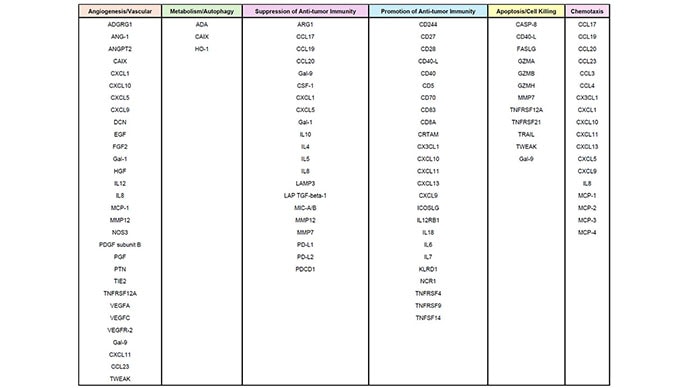
Although formally this is a cohort study, I might refer to it as a “deep phenotyping” study, or an “-omics” study. Essentially, this study measured a slew of biomarkers in the blood, in the cancer, and in the tissue surrounding the cancer. We’re talking 92 immune-oncologic protein markers and thousands of DNA and RNA markers. It’s a powerful approach, if computationally challenging.
But this is fundamentally a study about stress, and so the most important thing that was measured was the women’s level of stress across four domains: daily stress (this is the everyday stuff, such as work, family, and so on), racial discrimination, social isolation, and neighborhood deprivation.
These four sources of stress were linked to three broad outcomes: immune function writ large, immune function in the area around the tumor, and the biology of the tumor itself.
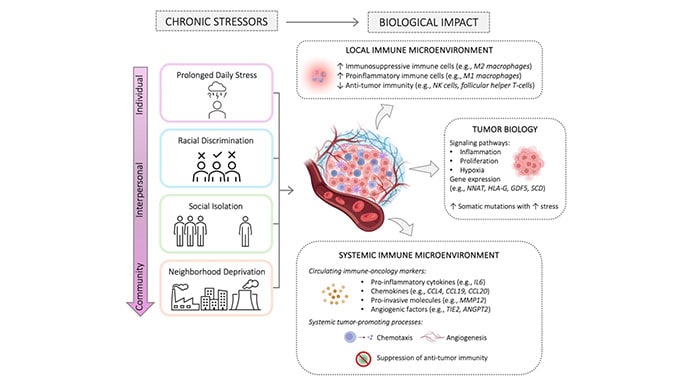
There’s a lot here, obviously, so I’ll give you the headline version. Broadly speaking, increased levels of stress screw up the immune system in ways that dramatically improve the environment for cancer cells. But let’s drill down a bit.
I’ll start with the immune system overall. The response to stress here is a bit complicated. In some ways, stress increases activity in the immune system — which would seem like a good thing. The immune system doesn’t only fight off bacteria and viruses, it also identifies cells that are misbehaving in your body and kills them before they can kill you. But the way stress revs up the immune system is not helpful in preventing cancer. More stress leads to higher levels of things like angiopoietins, which are substances that promote the growth of blood vessels into tissues. Targeting angiopoietins is a mainstay of cancer therapy, because tumors need blood vessels to sustain their growth, so the fact that stress increases their production is very much a bad thing.
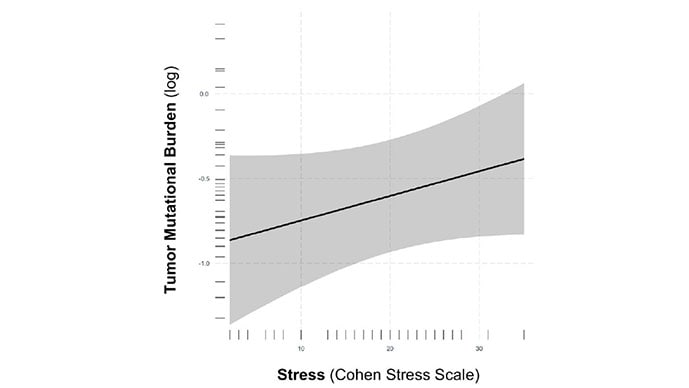
It might not all be bad. Higher levels of stress led to an increase in tumor mutational burden — more genetic errors in the tumor itself. This is a bit of a double-edged sword. Higher mutational burden can mean a more aggressive cancer, but at the same time the cancers may be more susceptible to immune checkpoint inhibitor therapy — blockbuster anti-cancer drugs.
It’s worth noting that these effects were generally more pronounced in Black compared with white women, which may provide some explanation on why breast cancer incidence and severity are higher in that population.
I should also note that although racial discrimination, social isolation, and neighborhood deprivation all had significant relationships with some pro-cancer markers, simple prolonged daily stress had the most consistent relationship across all the domains. Which makes sense, honestly. After all, things like racial discrimination, social isolation, and neighborhood deprivation increase stress levels — that’s probably part of the reason they have such adverse outcomes on health.
A study with this many comparisons between exposures and outcomes is necessarily going to be complex to process, and I see it more as an initial shotgun approach to understanding the convoluted interplay between psychology and biology that influences cancer growth than a definitive treatment of the subject. Future studies will no doubt drill down further on these issues, perhaps revealing new anti-tumor targets.
In the meantime, what do we do? Well, it may be time to add stress to our list of cancer risk factors.
F. Perry Wilson, MD, MSCE, is an associate professor of medicine and public health and director of Yale’s Clinical and Translational Research Accelerator. His science communication work can be found in the Huffington Post, on NPR, and here on Medscape. He posts at @fperrywilsonand his book, How Medicine Works and When It Doesn’t, is available now.