

Authors Al-Mahmud M, Das R, Yeasmeen S, et al.
Cureus 18(10): e118037. doi:10.7759/cureus.118037
Abstract
Background: Cardiopulmonary bypass provokes a systemic inflammatory response in children, with interleukin-6 (IL-6) levels rising rapidly after bypass. Corticosteroids are frequently used to blunt this response, but paediatric evidence remains inconsistent.
Objective: To evaluate whether a single intravenous dose of dexamethasone reduces the post-bypass increase in plasma IL-6 and improves early postoperative outcomes in children undergoing cardiac surgery with cardiopulmonary bypass.
Methods: This single-centre quasi-experimental study enrolled 46 children aged one month to 12 years undergoing elective repair of congenital heart disease between January 2025 and August 2025. Participants were purposively recruited and alternately allocated to intravenous dexamethasone (1 mg/kg, maximum 10 mg; n=23, 50.0%) or 2 mL normal saline (n=23, 50.0%) after induction of anaesthesia. Plasma IL-6 was measured before drug administration, two hours after cardiopulmonary bypass, and 24 hours after bypass. Haemodynamic variables, oxygen saturation, extubation time, and intensive care unit stay were recorded.
Results: The median IL-6 increase from baseline to two hours was lower with dexamethasone than with saline (261.90 pg/mL, interquartile range: 195.0-824.0, versus 447.0 pg/mL, interquartile range: 261.70-1,230.20), but the difference was not statistically significant (p=0.177). At 24 hours, the median change from baseline was 8.20 pg/mL in the dexamethasone group and 13.0 pg/mL in the saline group (p=0.350). Blood pressure, oxygen saturation, and extubation time were comparable. First-postoperative-day heart rate was higher with dexamethasone (143.63 ± 18.93 versus 117.76 ± 19.57 beats/min; p=0.001), and median intensive care unit stay was longer (120 versus 95.5 hours; p=0.001).
Conclusions: A single dose of intravenous dexamethasone at 1 mg/kg, capped at 10 mg, did not significantly attenuate the IL-6 response after paediatric cardiopulmonary bypass. The higher heart rate and longer intensive care stay observed in the dexamethasone group should be treated as exploratory because allocation was nonrandom and perioperative complexity was not adjusted for.
Introduction
Cardiopulmonary bypass (CPB) facilitates the repair of complex congenital heart disease. Nevertheless, it also exposes blood to synthetic surfaces, nonpulsatile flow, haemodilution, hypothermia, surgical trauma, ischaemia-reperfusion, and the heparin-protamine sequence. Together, these insults activate complement, coagulation, endothelial cells, leukocytes, and multiple cytokine pathways. The response is not merely biochemical. When pronounced, it may contribute to capillary leak, myocardial dysfunction, pulmonary injury, coagulopathy, kidney injury, and a prolonged need for organ support [1].
Children are particularly susceptible to CPB. The ratio of circuit prime to circulating blood volume is high, developmental haemostasis differs from that of adults, and the physiologic reserve of infants with congenital heart disease may be narrow. The inflammatory burden also varies with age, lesion, perfusion strategy, and duration of bypass. Consequently, a treatment that appears useful in one paediatric subgroup may have little effect in another. This heterogeneity has complicated interpretation of steroid trials for decades [2].
Interleukin-6 is a useful, although incomplete, marker of this response. It is a pleiotropic cytokine produced by monocytes, macrophages, endothelial cells, and other activated tissues [3]. Concentrations usually rise within the first hours after CPB and then decline over the following day. Higher exposure has been associated with longer bypass and greater tissue injury, but a single IL-6 value cannot distinguish the contributions of surgical trauma, perfusion, infection, and patient-level susceptibility [1]. Even so, its rapid kinetics and close relationship to the acute-phase reaction make it a practical biological endpoint in perioperative research.
Glucocorticoids offer an attractive intervention because they act at several points in the inflammatory cascade. After binding cytoplasmic glucocorticoid receptors, they modify gene transcription, reduce proinflammatory cytokine production, and influence endothelial and leukocyte activation. Dexamethasone is potent, inexpensive, widely available, and has a long biological half-life. An early paediatric study reported attenuation of the CPB inflammatory response after dexamethasone, whereas subsequent trials using different agents, doses, schedules, and age groups produced mixed biological and clinical findings [4-6].
Suppressing cytokines does not necessarily shorten ventilation or intensive care, and perioperative steroids may cause hyperglycaemia or other adverse effects. Moreover, evidence from lower-resource cardiac programmes is limited, even though constraints in circuit technology, case mix, and postoperative support may alter both inflammation and recovery [7]. We therefore evaluated a pragmatic, single-dose dexamethasone regimen in children undergoing CPB at a tertiary referral centre in Bangladesh. The primary question was whether intravenous dexamethasone 1 mg/kg, with a maximum dose of 10 mg, would reduce the rise in plasma IL-6. We also examined haemodynamics, oxygen saturation, time to extubation, and intensive care unit (ICU) length of stay.
Materials & Methods
Study design and setting
We conducted a prospective, single-centre, quasi-experimental study in the Cardiac Anaesthesia Unit and cardiothoracic ICU of the Department of Anaesthesia, Analgesia and Intensive Care Medicine, Bangladesh Medical University, Dhaka. Recruitment took place from January 2025 through August 2025. The institution is a government tertiary teaching and referral hospital equipped to provide paediatric cardiac surgery, cardiopulmonary bypass (CPB), invasive monitoring, mechanical ventilation, and immunologic laboratory testing.
The study employed a non-randomised design, with participants selected without blinding. Eligible participants were recruited purposively and assigned alternately to the saline-control group (Group N) or the dexamethasone group (Group D). The predictable allocation sequence is described explicitly because it affects the strength of causal inference.
Participants
Children aged one month to 12 years were eligible if they were scheduled for elective repair of a congenital heart defect using CPB. We included patients aged one month to 12 years to capture the full range of elective congenital cardiac repairs performed at this institution during the study period. The upper age limit of 12 years reflects the local departmental threshold, above which patients are generally transferred to the adult congenital cardiac surgery service. Participants of both sexes were included. Exclusion criteria comprised refusal of guardian consent, preoperative steroid therapy for adrenocortical or immunologic conditions, and complex congenital lesions (Table 1).
Before completion of the pre-anaesthetic assessment, the investigating anaesthesiologist verbally explained the study protocol, procedures, and associated risks in Bengali to each guardian and provided a written information sheet. Guardians were allowed to ask questions and were informed of their right to withdraw at any stage without affecting their child’s clinical care. We did not obtain participant consent because their age precluded comprehension of the procedure.
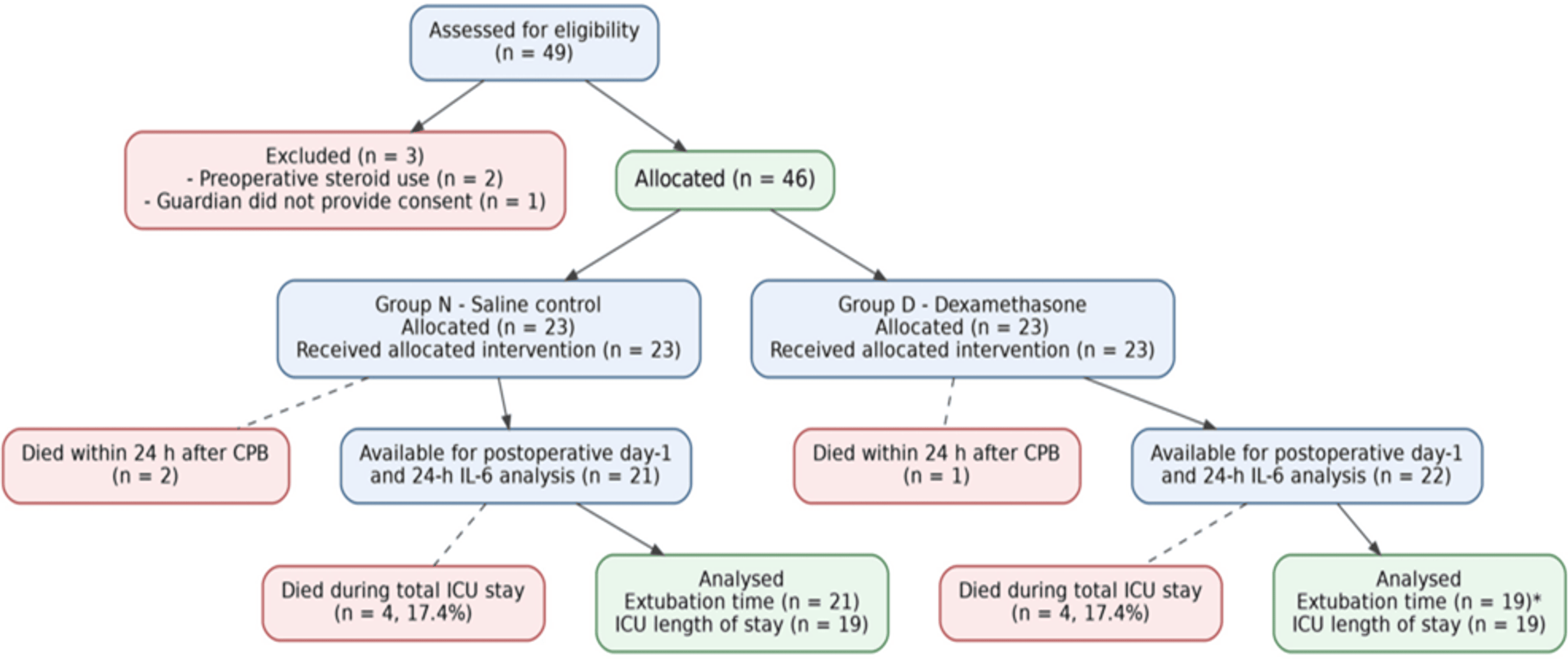
Forty-nine children were assessed for eligibility; two were excluded because they were receiving preoperative steroids, and one was excluded because a guardian did not provide consent. The final cohort included 46 participants, with 23 allocated to the saline control group and 23 to the dexamethasone group. As shown in Figure 1, the target sample size was 23 participants per group.
The sample size calculation used a previously reported treatment-group IL-6 mean of 113.8 pg/mL and a standard deviation of 7.7 pg/mL, an anticipated 5% mean difference, a 5% significance level, and 80% power [8].
Intervention and perioperative care
After standard monitoring and induction of general anaesthesia, we obtained a baseline arterial blood sample. Group D then received dexamethasone 1 mg/kg intravenously, capped at 10 mg; Group N received 2 mL normal saline. The study drug was administered after induction, approximately one hour before CPB initiation.
Anaesthetic management was conducted in accordance with the unit’s protocol. The induction phase involved administering fentanyl at a dose of 3 µg/kg; for patients with right-to-left shunts, a combination of midazolam (0.1 mg/kg) and ketamine (1 mg/kg) was used, while those with left-to-right shunts received midazolam (0.1 mg/kg) alongside thiopental (3 mg/kg). Following this, vecuronium at 0.1 mg/kg was administered, and tracheal intubation was performed. Anaesthesia was maintained with isoflurane in a 1:1 air-oxygen mixture, supplemented with continuous intravenous infusions of fentanyl (1 µg/kg/hour), vecuronium (1-2 µg/kg/minute), and dexmedetomidine (0.5-1 µg/kg/hour). The dexmedetomidine dosage was adjusted based on hemodynamic responses. In the intensive care unit, dexmedetomidine was continued at 0.3-0.5 µg/kg/hour for all 46 participants (100%) until the first postoperative day. Radial arterial and central venous access were established. Before bypass, heparin 400 U/kg was administered and activated clotting time was maintained at 480 seconds or longer. Protamine was given after CPB, and adrenaline, dobutamine, or milrinone was used according to hemodynamic need. Postoperatively, all patients were transferred intubated to the cardiothoracic ICU and managed by the usual multidisciplinary team.
Outcomes and laboratory assessment
Plasma IL-6 was the primary biological outcome; no other cytokines or acute-phase markers (e.g., IL-8, IL-10, tumour necrosis factor alpha (TNF-α), or CRP) were measured in this study. Two-millilitre arterial blood samples were collected into citrate-anticoagulated tubes before administration of the intervention, two hours after weaning from CPB, and 24 hours after CPB. Plasma IL-6 was measured in the Microbiology and Immunology Laboratory using an immunofluorescence assay.
Heart rate, systolic blood pressure, diastolic blood pressure, mean arterial pressure, and peripheral oxygen saturation (SpO2) were recorded preoperatively, at weaning from CPB, immediately postoperatively, and on the first postoperative day. Clinical outcomes were time from surgery to extubation and duration of ICU stay. CPB duration was recorded as a potential confounder. Mortality was not prespecified as a primary outcome, but deaths were documented in participant flow.
Data analysis
Data were analysed in IBM SPSS Statistics, version 25 (IBM Corporation Inc., Chicago, Illinois, USA). Continuous variables were summarised as mean ± standard deviation when approximately normally distributed and as median with range or interquartile range when skewed. Categorical variables were reported as frequency and percentage. Normality was assessed with the Shapiro-Wilk test and by visual inspection of histograms and Q-Q plots.
Between-group comparisons used the independent-samples t test for normally distributed continuous variables, the Mann-Whitney U test for nonnormally distributed variables, and the chi-square test for categorical variables. Two-sided p values below 0.05 were considered statistically significant. The source analysis was complete-case at each time point; no imputation and no multivariable adjustment were performed. Because several secondary outcomes and time points were tested without correction for multiplicity, statistically significant secondary findings should be interpreted as exploratory.
Results
Participant flow and baseline characteristics
All 46 (100%) enrolled participants received the assigned intervention. The saline and dexamethasone groups were similar in age, sex, body mass index, and overall diagnostic distribution (Table 2).
Median age was 5.0 years in Group N and 7.0 years in Group D (p=0.440). Male participants accounted for 13/23 (56.5%) in Group N and 12/23 (52.2%) in Group D; female participants accounted for 10/23 (43.5%) and 11/23 (47.8%), respectively. The sex distribution did not differ significantly between groups (χ²(1, N=46)=0.088, p=0.767, Cramér’s V=0.044). In Group N, the diagnoses were atrial septal defect in 6/23 (26.1%), total anomalous pulmonary venous connection in 2/23 (8.7%), tetralogy of Fallot in 6/23 (26.1%), and ventricular septal defect in 9/23 (39.1%). In Group D, the corresponding frequencies were 3/23 (13.0%), 1/23 (4.3%), 10/23 (43.5%), and 9/23 (39.1%). Overall diagnostic distribution did not differ significantly between groups (χ²(3, N=46)=2.333, p=0.506, Cramér’s V=0.225) (Table 3).
Median CPB duration was 79 minutes (range 45-150) with saline and 86 minutes (range 50-260) with dexamethasone (p=0.056). Death within 24 hours of CPB occurred in 2/23 (8.7%) participants in Group N and 1/23 (4.3%) participant in Group D, leaving 21/23 (91.3%) and 22/23 (95.7%), respectively, for first-postoperative-day measurements. The study further reports death during the total ICU stay in 4/23 (17.4%) participants in each group. Denominators for extubation and ICU-stay analyses varied, as shown in Table 4.
Among participants with recorded extubation data, measurements were available for 21/23 (91.3%) participants in Group N and 19/23 (82.6%) in Group D. Median time to extubation was 7 hours (range: 4-30) and 18 hours (range: 5-26), respectively (p=0.226). ICU-stay data were available for 19/23 (82.6%) participants in each group; median ICU stay was 95.5 hours (range: 49-138) with saline and 120 hours (range: 70-335) with dexamethasone (p=0.001).
Interleukin-6 response
Baseline IL-6 concentrations were heterogeneous. The median was 78 pg/mL (range: 8.9-903.9) in Group N and 44 pg/mL (range: 5.5-1620.1) in Group D (p=0.668). At two hours after CPB, IL-6 increased markedly in both groups, reaching a median of 583.30 pg/mL (range: 167.30-1,818.50) with saline and 344.20 pg/mL (range: 160-4,010) with dexamethasone (p=0.362). At 24 hours, concentrations had fallen toward baseline: 98 pg/mL (range: 14.1-216.0) in Group N and 79.15 pg/mL (range: 19.2-1101.3) in Group D (p=0.520) (Table 5).
The change-score analysis yielded the same overall conclusion. From baseline to two hours, the median IL-6 rise was 447.0 pg/mL (interquartile range: 261.70-1230.20) in Group N and 261.90 pg/mL (interquartile range: 195.0-824.0) in Group D. Although the point estimate favoured dexamethasone, the between-group difference was not statistically significant (p=0.177). At 24 hours, median changes from baseline were 13.0 and 8.20 pg/mL, respectively (p=0.350).
Hemodynamic and oxygenation outcomes
Heart rate was comparable before surgery and at CPB weaning. Immediately after surgery, the dexamethasone group had a higher mean heart rate, but the difference was not statistically significant (133.56 ± 17.90 versus 119.91 ± 29.48 beats/min; p=0.066). On the first postoperative day, mean heart rate was 143.63 ± 18.93 beats/min in Group D and 117.76 ± 19.57 beats/min in Group N (p=0.001) (Table 6).
The unadjusted mean difference was 25.87 beats/min; the approximate 95% confidence interval, calculated from the reported summary statistics, was 14.00-37.74 beats/min. No significant between-group differences were identified in systolic, diastolic, or mean arterial pressure at any measured time point. SpO2 was also similar preoperatively, at weaning, immediately postoperatively, and on the first postoperative day (Table 4).
Clinical outcomes
Among participants with recorded extubation data, median time to extubation was 7 hours (range: 4-30; n=21) in Group N and 18 hours (range: 5-26; n=19) in Group D (p=0.226). Median ICU stay, based on 19 participants in each group, was 95.5 hours (range: 49-138) with saline and 120 hours (range: 70-335) with dexamethasone (p=0.001).
Discussion
This study tested a practical question: does one dose of dexamethasone, given after induction and before bypass, meaningfully suppress the early IL-6 response in children? Within the limits of this dataset, the answer was no. IL-6 rose sharply in both groups at two hours and declined by 24 hours. The median two-hour increase was smaller in children who received dexamethasone, but the distributions were wide, and the between-group difference was not statistically significant. Blood pressure and oxygenation followed similar courses. At the same time, heart rate on the first postoperative day and ICU stay were higher in the dexamethasone group. Those latter findings are noteworthy, but they should not be read as proof of steroid-related harm.
The direction of the IL-6 effect is biologically plausible. Earlier paediatric work using dexamethasone reported a reduced inflammatory response after CPB [9]. A larger trial that used three scheduled 1 mg/kg dexamethasone doses also found lower IL-6 at six and 24 hours, although short-term clinical outcomes did not improve [10]. By contrast, our regimen consisted of a single dose with an absolute ceiling of 10 mg. Older or heavier children therefore received less than 1 mg/kg, and concentrations in relevant tissue compartments may have been insufficient for a consistent effect. The timing of sampling also matters. A transient difference before two hours, or between the two- and 24-hour samples, would not have been captured.
Trials of methylprednisolone reinforce the distinction between biological modulation and clinical benefit. High-dose methylprednisolone in neonates has reduced IL-6 and IL-8 and increased IL-10 without clear improvement in myocardial injury or recovery [11]. Additional preoperative dosing did not produce sustained postoperative suppression in another neonatal trial [12], while administration at induction appeared more effective against selected inflammatory markers than delivery in the CPB prime [13]. A prolonged stress-dose regimen improved some hemodynamic measures and lowered postoperative IL-6, but it was a substantially different intervention from the single dose tested here [14]. In other words, corticosteroid effects are sensitive to agent, dose, timing, age, lesion, and outcome definition. Pooling them as though they were interchangeable can obscure clinically important differences.
The broad evidence base remains equivocal. A Cochrane review and paediatric meta-analysis concluded that steroids can influence inflammatory markers and fluid balance, yet evidence for consistent improvements in ventilation, ICU stay, major morbidity, or mortality is uncertain [5,15]. The large multicentre STRESS trial found no significant benefit of methylprednisolone on its adjusted primary composite outcome in infants, while postoperative insulin treatment for hyperglycaemia was substantially more frequent [16]. More recent meta-analyses similarly suggest selective short-term effects without a convincing basis for routine prophylaxis across all infants [17,18]. Our null IL-6 result and lack of improvement in extubation align with that caution.
Several factors may explain the imprecision in our IL-6 estimates. First, baseline concentrations were strikingly variable, including extreme values in both groups. Change scores can reduce some baseline imbalance, but they remain unstable in a small sample with skewed data [19,20]. Second, CPB exposure was numerically longer in the dexamethasone group and extended to 260 minutes in one or more participants. Bypass duration is associated with cytokine release [21]; even a modest imbalance could offset a pharmacologic effect. Third, the cohort ranged from infants to 12-year-old children and included several congenital diagnoses. Beyond bypass duration, the procedures included in this cohort varied substantially in the degree of myocardial and tissue trauma incurred. For example, tetralogy of Fallot repair, which often entails ventriculotomy or placement of a transannular patch, constitutes a markedly greater surgical insult than simple septal defect closure, irrespective of bypass duration. Although diagnostic distributions did not differ significantly between groups, variability in surgical trauma may have independently contributed to the broad IL-6 ranges observed at each time point. Future studies should therefore either restrict enrolment to a single lesion category or adjust explicitly for procedure type.
The inflammatory response, circuit-to-blood-volume ratio, surgical complexity, and postoperative trajectory differ substantially across that span [22]. The higher first-day heart rate deserves a measured interpretation. Dexamethasone may increase catecholamine responsiveness and can produce hyperglycaemia, but the study did not collect glucose, insulin treatment, vasoactive-inotropic scores, fever, pain scores, or fluid balance. Any of these could influence heart rate. The numerical differences in lesion distribution and CPB duration may also explain the association. Without adjustment, we cannot confidently attribute the observed association to dexamethasone.
The same caution applies to ICU length of stay. Median stay was 24.5 hours longer in the dexamethasone group, with a range extending to 335 hours. A few clinically complex patients can strongly influence rank-based comparisons in a cohort of this size. Moreover, extubation and ICU analyses used different denominators. Death within 24 hours occurred in 2/23 (8.7%) saline-group participants and 1/23 (4.3%) dexamethasone-group participant, while death during the total ICU stay was reported in 4/23 (17.4%) participants in each group (Figure 1).
The reasons for all missing observations were not fully specified. Therefore, the significant p-value indicates a difference among the available observations rather than a definitive causal effect and should not be interpreted as evidence that dexamethasone prolonged ICU care. The study nevertheless has strengths. It prospectively applied a predefined intervention in a real-world paediatric cardiac program, used a contemporaneous saline-control group, measured IL-6 at biologically relevant time points, and recorded both laboratory and clinical outcomes. It also contributes evidence from Bangladesh, a setting underrepresented in paediatric CPB trials. The observed IL-6 trajectory, rapid rise followed by substantial decline at 24 hours, supports the internal biological coherence of the measurements.
As this prospective academic observational/interventional research project was not registered in a clinical trial registry, the findings should be interpreted in light of this limitation. Purposive recruitment and alternate allocation introduced selection and allocation bias, and the sequence could not conceal upcoming treatment. Blinding was not documented. The single-centre sample was small, and the sample-size assumptions were based on a much smaller variance than was observed; the study was therefore vulnerable to type II error. No multivariable model adjusted for CPB duration, diagnosis, age, surgical complexity, or vasoactive support. Dexmedetomidine was adjusted based on clinical judgment, and its total dosage was not evaluated across different groups. Since dexmedetomidine lowers IL-6 levels and heart rate during cardiac procedures [23], any variation in its administration may have independently affected IL-6 and initial heart rate results, separate from the effects of dexamethasone. IL-6 was the only inflammatory biomarker, and no clinical syndrome definition for postoperative systemic inflammation was applied. Multiple secondary comparisons were made without multiplicity correction. Finally, missing data and deaths changed denominators, and available-case analyses can be biased when missingness is related to illness severity.
Future studies should use computer-generated randomisation with allocation concealment, prespecified age or surgical-complexity strata, and standardised reporting of CPB and cross-clamp times. A broader panel including IL-6, IL-8, IL-10, tumour necrosis factor-alpha, and routine acute-phase markers would better characterise immune modulation. Repeated-measures models could use all available cytokine data while accounting for baseline values. Clinical endpoints should include vasoactive-inotropic score, glucose and insulin exposure, fluid balance, kidney injury, infection, ventilation duration, ICU-free days, and mortality. Such work would clarify whether a particular dexamethasone regimen benefits a definable subgroup rather than the heterogeneous paediatric CPB population as a whole.
Conclusions
In this quasi-experimental cohort, intravenous dexamethasone 1 mg/kg, capped at 10 mg and administered after induction, did not significantly attenuate the rise in plasma IL-6 two hours after paediatric cardiopulmonary bypass. IL-6 concentrations declined toward baseline by 24 hours in both groups, and no clear differences were observed in blood pressure, oxygen saturation, or time to extubation. Heart rate on the first postoperative day and ICU length of stay were higher in the dexamethasone group. These findings should remain exploratory because treatment allocation was nonrandom, bypass exposure and case complexity were not adjusted for, and outcome denominators changed after deaths and missing observations. The present results do not support routine use of this single-dose regimen solely to suppress IL-6. Larger randomized trials incorporating rigorous allocation procedures, comprehensive inflammatory profiling, and clinically relevant outcomes are required to establish a safe and effective perioperative dexamethasone strategy.
References
- Banerjee D, Feng J, Sellke FW: Strategies to attenuate maladaptive inflammatory response associated with cardiopulmonary bypass. Front Surg. 2024, 11:1224068. 10.3389/fsurg.2024.1224068
- Bierer J, Stanzel R, Henderson M, et al.: Novel inflammatory mediator profile observed during pediatric heart surgery with cardiopulmonary bypass and continuous ultrafiltration. J Transl Med. 2023, 21:439. 10.1186/s12967-023-04255-8
- Del Valle DM, Kim-Schulze S, Huang HH, et al.: An inflammatory cytokine signature predicts COVID-19 severity and survival. Nat Med. 2020, 26:1636-43. 10.1038/s41591-020-1051-9
- Howell KW, Cleveland JC Jr, Meng X, Ao L, Su X, Schwartz RS, Fullerton DA: Interleukin 6 production during cardiac surgery correlates with increasing age. J Surg Res. 2016, 201:76-81. 10.1016/j.jss.2015.10.016
- Bronicki RA, Flores S, Loomba RS, et al.: Impact of corticosteroids on cardiopulmonary bypass induced inflammation in children: a meta-analysis. Ann Thorac Surg. 2021, 112:1363-70. 10.1016/j.athoracsur.2020.09.062
- Li Y, Luo Q, Wu X, Jia Y, Yan F: Perioperative corticosteroid therapy in children undergoing cardiac surgery: a systematic review and meta-analysis. Front Pediatr. 2020, 8:350-10. 10.3389/fped.2020.00350
- Al-Fares A, Pettenuzzo T, Del Sorbo L: Extracorporeal life support and systemic inflammation. Intensive Care Med Exp. 2019, 7:46. 10.1186/s40635-019-0249-y
- Abd El-Hakeem EE, Ashry MA, El-Minshawy A, Maghraby EA: Influence of dexamethasone on cytokine balance in patients undergoing valve replacement surgery. Eg J Anaesth. 2003, 19:205-14.
- Bronicki RA, Backer CL, Baden HP, Mavroudis C, Crawford SE, Green TP: Dexamethasone reduces the inflammatory response to cardiopulmonary bypass in children. Ann Thorac Surg. 2000, 69:1490-5. 10.1016/s0003-4975(00)01082-1
- Amanullah MM, Hamid M, Hanif HM, et al.: Effect of steroids on inflammatory markers and clinical parameters in congenital open heart surgery: a randomised controlled trial. Cardiol Young. 2016, 26:506-15. 10.1017/S1047951115000566
- Jin Y: Abstract 4144734: Effect of methylprednisolone on inflammation and clinical outcomes in neonates undergoing cardiac surgery: a randomized controlled trial. Circulation. 2024, 150:10.1161/circ.150.suppl_1.4144734
- Graham EM, Atz AM, McHugh KE, et al.: Preoperative steroid treatment does not improve markers of inflammation after cardiac surgery in neonates: results from a randomized trial. J Thorac Cardiovasc Surg. 2014, 147:902-8. 10.1016/j.jtcvs.2013.06.010
- Keski-Nisula J, Suominen PK, Olkkola KT, et al.: Effect of timing and route of methylprednisolone administration during pediatric cardiac surgical procedures. Ann Thorac Surg. 2015, 99:180-5. 10.1016/j.athoracsur.2014.08.042
- Suominen PK, Keski-Nisula J, Ojala T, et al.: Stress-dose corticosteroid versus placebo in neonatal cardiac operations: a randomized controlled trial. Ann Thorac Surg. 2017, 104:1378-85. 10.1016/j.athoracsur.2017.01.111
- Gibbison B, Villalobos Lizardi JC, Avilés Martínez KI, et al.: Prophylactic corticosteroids for paediatric heart surgery with cardiopulmonary bypass. Cochrane Database Syst Rev. 2020, 10:013101. 10.1002/14651858.CD013101.pub2
- Hill KD, Kannankeril PJ, Jacobs JP, et al.: Methylprednisolone for heart surgery in infants: a randomized, controlled trial. N Engl J Med. 2022, 387:2138-49. 10.1056/NEJMoa2212667
- Chen D, Du Y: Analysis of perioperative corticosteroid therapy in children undergoing cardiac surgery: a systematic review and meta-analysis. Clin Cardiol. 2023, 46:607-14. 10.1002/clc.24018
- Wang S, Xu Y, Yu H: Prophylactic corticosteroids for infants undergoing cardiac surgery with cardiopulmonary bypass: a systematic review and meta-analysis of randomized controlled trials. BMC Anesthesiol. 2024, 24:385. 10.1186/s12871-024-02772-7
- Puchinger J, Ryz S, Nixdorf L, et al.: Characteristics of interleukin-6 signaling in elective cardiac surgery: a prospective cohort study. J Clin Med. 2022, 11:590. 10.3390/jcm11030590
- Yuan SM, Lin HZ: Interleukin-6 in cardiac surgery. Period Biol. 2017, 119:93-9. 10.18054/pb.v119i2.4928
- Eggum R, Ueland T, Mollnes TE, et al.: Effect of perfusion temperature on the inflammatory response during pediatric cardiac surgery. Ann Thorac Surg. 2008, 85:611-7. 10.1016/j.athoracsur.2007.10.062
- Mahle WT, Matthews E, Kanter KR, Kogon BE, Hamrick SE, Strickland MJ: Inflammatory response after neonatal cardiac surgery and its relationship to clinical outcomes. Ann Thorac Surg. 2014, 97:950-6. 10.1016/j.athoracsur.2013.10.069
- Wang K, Wu M, Xu J, Wu C, Zhang B, Wang G, Ma D: Effects of dexmedetomidine on perioperative stress, inflammation, and immune function: systematic review and meta-analysis. Br J Anaesth. 2019, 123:777-94.