

Authors: Chauhan V
Cureus 18(10): e118172. doi:10.7759/cureus.118172
Abstract
Introduction: Preoperative fasting guidelines recommend clear fluids up to two hours before surgery to prevent prolonged fasting times and pulmonary aspiration. Gastric ultrasound is a safe, valid, non-invasive and readily available tool that can be used to look for the residual gastric volumes (GVs) and to confirm the fasting status in case of doubtful fasting period. The aim of this study was to evaluate ultrasound-guided assessment of GVs in children receiving either 5% dextrose water or plain water preoperatively, and to look for the incidence of postoperative nausea and vomiting (PONV) and thirst.
Methods: The study was approved by the Institutional Ethics Committee and registered with CTRI with trial number CTRI/2023/09/057732. This prospective, randomised, controlled study included 60 American Society of Anesthesiologists (ASA) I-II paediatric patients (5-12 years) undergoing elective surgery. Gastric antral cross-sectional area (CSA) and volumes were measured. Patients received 3 mL/kg of either 5% dextrose water (Group A) or plain water (Group B) two hours before surgery. The primary outcome was the measurement of GV at baseline and two hours. Ultrasound assessments were performed at baseline and two hours after fluid intake. Secondary outcomes included the incidence of PONV and thirst in the postoperative period.
Results: The study found no significant differences in antral CSA or volume between the two groups at baseline and two hours. At baseline, CSA: t = -0.900, p=0.372, effect size (Cohen’s d) = -0.232 (95% CI: -0.580 to 0.220); GV: t= -0.800, p=0.427, effect size (Cohen’s d) = -0.207 (95% CI: -3.660 to 1.569). After two hours, CSA: t=0.579, p=0.565, effect size (Cohen’s d) = 0.149 (95% CI: -0.268 to 0.486); GV: t = -0.561, p=0.577, effect size (Cohen’s d) = -0.145 (95% CI: -3.396 to 1.910). PONV was absent in both groups, and the prevalence of thirst did not differ significantly.
Conclusion: Administering 5% dextrose water or plain water two hours preoperatively has similar effects on residual GVs in paediatric patients. The choice between the two fluids did not influence PONV or thirst significantly.
Introduction
The use of ultrasound in the assessment of gastric volumes (GVs) has been widely done recently in preoperative paediatric and adult patients. Gastric ultrasound being a safe, valid, non-invasive and readily available tool can be used to look for the residual GVs and to confirm the prandial status in case of doubtful fasting status. Preoperative fasting is usually recommended to ensure empty stomach at the time of surgery, thus preventing pulmonary aspiration. But in certain patients, nil per oral status may be doubtful, where the parents or attendants may not be able to recall the time of last meal or in cases where there is any communication or language barrier.
As per the recommendations, children should be allowed to have clear fluids till two hours before surgery that may include water, carbohydrate-containing drinks such as glucose or dextrose water, apple juice, green tea, or any other pulp-free juice. Adhering to the fasting guidelines helps in avoiding prolonged fasting times and allowing clear fluids till two hours before surgery may prevent the child from having episodes of hypoglycemia and dehydration, which may lead to hypotension. Prolonged fasting periods can also lead to increased thirst and irritability among children [1]. Thus, allowing clear fluids preoperatively reduces thirst or hunger and provides a feeling of subjective wellbeing [2]. So this study was conducted to assess and compare the GVs in children using ultrasound by allowing them to ingest clear fluids two hours before the surgery as per the recommendations and its effects on the incidence of postoperative nausea-vomiting and thirst. By calculating the cross-sectional area (CSA) of the antrum in the right lateral decubitus (RLD) position, the GV can be calculated by using the recommended formula for the paediatric patients [3,4].
The type of gastric content present in the antrum whether it is solid or liquid can be easily identified using ultrasonography. In case whether any solid content is found or the gastric fluid volume is more than 1.5 mL/kg, it is considered as full stomach and the patient has a high risk of aspiration. The gastric emptying of carbohydrate-containing fluids is considered to be slower because of its energy density as compared with plain water [5]. None of the studies conducted so far have compared GVs in paediatric patients using 5% dextrose water versus plain water. So, this study was conducted with the primary objective to compare and assess the GVs two hours after ingestion of 5% dextrose water versus plain water using ultrasound and secondarily to look for the incidence of postoperative nausea-vomiting and thirst in these patients.
Materials & Methods
After obtaining Institutional Ethics Committee approval, this prospective, randomised, controlled, double-blind study was carried out on 60 patients. All children with American Society of Anesthesiologists (ASA) physical status grade I and II aged 5 to 12 years scheduled for elective surgery were included. The study was conducted from September 2023 to March 2024 in the Department of Anaesthesiology of a paediatric hospital in New Delhi. Written informed consent was obtained from all the participants. The children aged 5 to 12 years undergoing elective surgery, with ASA physical status grade I to II and posted for surgery after 11 a.m., were enrolled in the study. Children with a history of any gastrointestinal disease, hiatus hernia, or those being treated with medications affecting gastrointestinal motility, such as antidiarrheal medications, those posted for day care surgery or those refusing to accept feeds were excluded from the study.
Methodology
Children who fulfilled the inclusion criteria were allocated into two groups (Group A and Group B) using a computer-generated random number table (Table 1). Randomisation was carried out using permuted blocks of varying sizes (http://www.randomization.com). After obtaining the randomisation sequence, the treatment category was transcribed to consecutively numbered opaque envelopes. A preoperative ward visit was conducted the day before surgery, and fasting orders were explained. On the day of surgery, the children underwent a baseline gastric ultrasound examination in both supine and RLD position by the investigator in the preoperative area. The number of hours of overnight fasting was noted. After that, 3 mL/kg of clear fluids (5% dextrose water in Group A and plain water in Group B) were given to the children by nursing staff who were not part of the study. Both types of fluids were provided to the children in similar-looking cups. The principal investigator performing the ultrasound and the patients were blinded. The second gastric ultrasound examination was performed after two hours of giving clear fluids, just before induction.
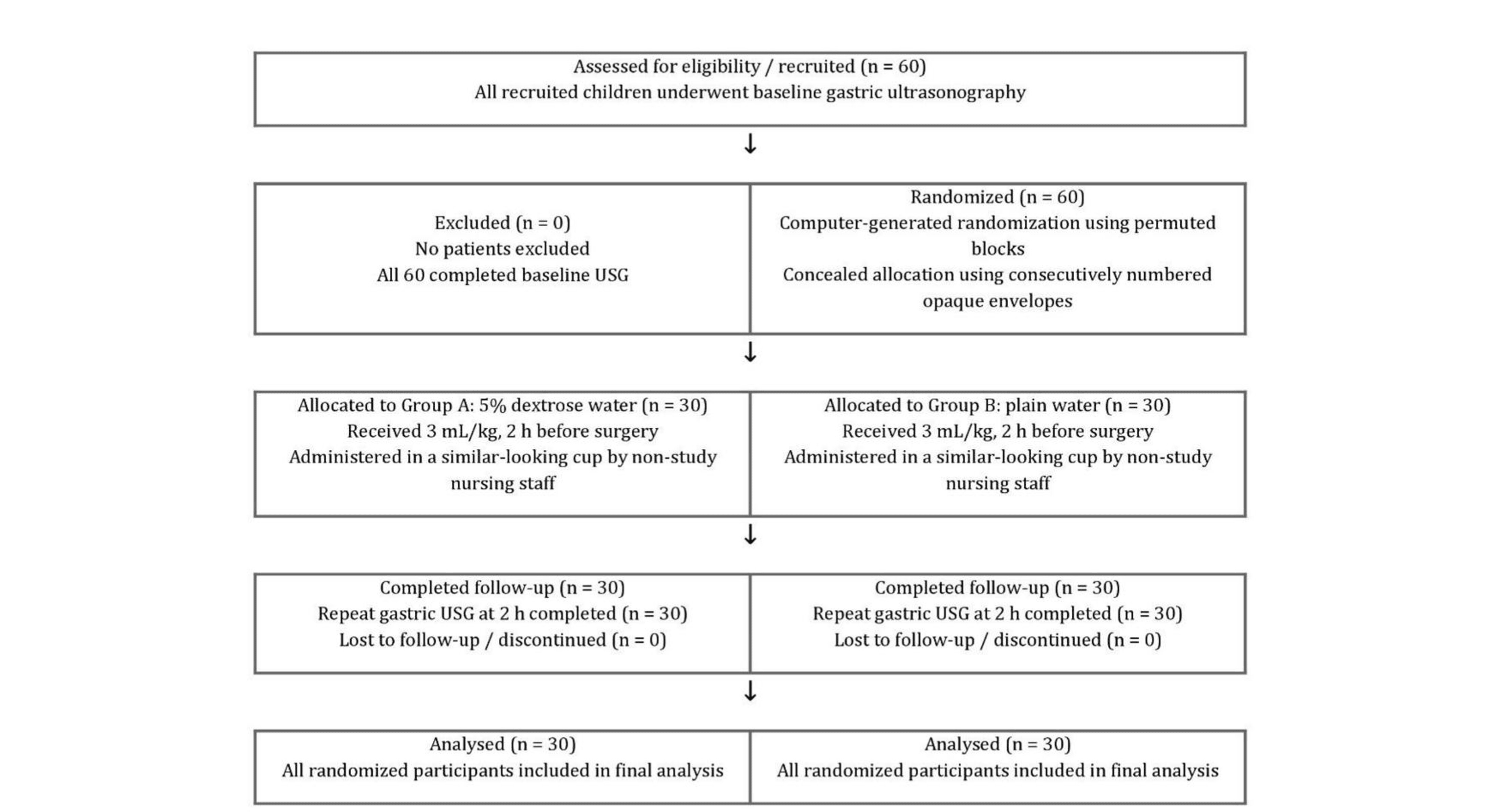
The children were allocated into two groups: Group A received 5% dextrose water and Group B received plain water two hours before the surgery. All ultrasound examinations were performed by a single investigator who was trained for gastric ultrasound examination. Each ultrasound examination was performed first in supine and then in the RLD position. GVs for all patients were calculated in RLD position. A high resolution 6.5 to 13 MHz linear array transducer with M-Turbo Sonosite USG machine (Sonosite, WA, USA) was used to perform the ultrasound examination. The gastric antrum was scanned in sagittal plane in the epigastric region while visualizing the left lobe of the liver, either aorta or inferior venacava [4]. The maximum anteroposterior diameter (D1) and craniocaudal or longitudinal diameter (D2) were measured from serosa to serosa in the RLD position. The antral CSA was then calculated according to the following formula:
Subsequently, GV was calculated using a previously validated mathematical formula specific to children [3,4]:
Qualitative assessment of gastric contents was performed using a 3-point qualitative grading scale described by Perlas et al. [6]. Grade 0 was defined as the absence of any content in a flat antrum in both the supine and the RLD positions. Grade 1 was defined as the appearance of fluid content in the RLD position only, and grade 2 as the appearance of fluid content in both the RLD and supine positions.
After two hours of giving fluids, just before the surgery, a repeat ultrasound was performed and any complaint of child feeling thirsty was noted. After that, the child was taken inside the operating room and standard ASA monitors were attached. An intravenous cannula was already secured preoperatively in the ward as per our institution protocol. All patients underwent a standardized general anaesthetic protocol that included induction with fentanyl 2 mcg/kg and propofol 2 mg/kg, neuromuscular block with atracurium 0.5 mg/kg and maintenance with isoflurane or sevoflurane and an air-oxygen mixture. The surgery proceeded as planned based on standard clinical practice. All patients received an injection of ondansetron in a dose of 0.1 mg/kg 30 minutes before the completion of surgery. Once the surgery was over and extubation was performed, the child was shifted to the recovery room and monitored for two hours. Any episodes of nausea or vomiting were noted in the postoperative period. After two hours of monitoring in the postoperative recovery area, the child was shifted to the ward.
Sample size calculation and statistical analysis
Our estimated sample size is based on the primary objective of comparing mean GV in pediatric patients receiving dextrose water versus plain water pre-operatively, derived from the previous study by Zhang et al. [7]. A sample size of 27 patients per group, with an effect size of 0.88, provided 90% power to detect a significant difference between the two groups at an alpha level of 0.05. Considering a dropout rate of 10%, we took 30 patients in each group.
Data obtained in this study were processed in Microsoft Excel 2010 (Microsoft Corp., Redmond, WA). Descriptive statistics were performed using the mean and standard deviation for quantitative variables, and categorical variables were presented as frequencies along with respective percentages. The statistical comparisons for quantitative variables were performed using Student’s t‑test, and for categorical variables, the chi-square test was used according to the data. All statistical analyses were performed using SPSS software (version 22; IBM Corp., Armonk, NY). Results were discussed at the 5% level of significance, i.e., p<0.05 was considered statistically significant.
Results
A total of 30 patients were included each in Group A and Group B. The demographic data of the two groups are represented in Table 1. Baseline demographic and clinical characteristics, including age, weight, fasting duration, gender distribution and ASA physical status classification, were comparable between Group A and Group B, showing no statistically significant differences (p>0.05). Male predominance was observed in both groups (86.7% in Group A vs. 73.3% in Group B; p=0.197). Duration of fasting in terms of number of hours was also comparable between Group A (9.90±3.63 hours) and Group B (9.67±1.24 hours; p=0.307). GVs were also comparable between the two groups. There was no significant difference observed in GVs at two hours between the two groups. None of the patients crossed the threshold of 1.5 mL/kg for GVs (Table 2). All 30 participants in each group reported “No” for postoperative nausea and vomiting (PONV), resulting in a 100% absence of PONV occurrences in both groups based on the provided data. The comparison between Group A (23.33% reporting thirst/hunger) and Group B (36.66% reporting thirst/hunger) showed no significant difference in the prevalence of thirst/hunger between the two groups.
The RLD gastric antral CSA was comparable between Group A and Group B at both baseline and two hours of giving clear fluids (Table 3). There was no statistically significant differences observed between the two groups.
Similarly, there were no statistically significant differences observed in GVs in both groups at baseline or two hours, as represented in Table 4. At baseline, the mean GV was 11.46±4.73 mL in Group A and 12.51±5.37 mL in Group B (p=0.425). At two hours, mean GVs were 11.28±5.39 mL and 12.02±4.86 mL for Group A and Group B, respectively (p=0.579).
Discussion
The current study aimed to assess and compare GVs in paediatric patients receiving 5% dextrose water versus plain water preoperatively using ultrasound guidance. The primary objective was to evaluate the mean GV in both groups, while the secondary objective focused on the effects of allowing clear fluids on the incidence of PONV and thirst.
Ingestion of clear fluids till two hours before surgery is recommended to prevent dehydration, hypotension and discomfort because of prolonged fasting. The choice of clear fluids administered may vary across various institutions, especially in paediatric patients. Some centres may prefer giving plain water, while some may give dextrose-containing fluids or water. Due to concern regarding the gastric emptying of dextrose-containing fluid, plain water is often administered more frequently to paediatric patients. The use of ultrasound to assess GVs is being extensively used due to its safety, validity and non-invasiveness. This study was conducted to assess and compare any differences in GVs when paediatric patients received 5% dextrose water versus plain water preoperatively. The hypothesis postulated that the energy density of dextrose-containing fluids is higher than that of plain water, which may cause a potential delay in gastric emptying and consequently may increase residual GVs. The results, however, did not support this hypothesis.
Various studies demonstrate the usefulness of ultrasound in evaluating gastric contents in paediatric patients. Kadir and his colleagues [8] assessed the GVs in paediatric non-surgical patients fasted for various reasons, as compared to our study after performing the baseline ultrasound, they measured the GVs after one hour and two hour of giving 3 mL per kg of blackcurrant flavoured clear fluid, they found higher residual GVs at one hour (T1) than volumes at two hours (T2). However, similar to our study, they did not find any significant differences between baseline and two-hour GVs. Their study being similar to our study thus helps in providing valuable information on the effects of different clear fluids when given preoperatively. Another study by Desgranges and colleagues [9] also proves the utility of gastric ultrasound in assessing GVs in paediatric patients to look for ingested blood after undergoing elective ear, nose and throat surgeries. As per our hypothesis, no statistically significant differences were observed in the CSA and GV in our study between the group receiving 5% dextrose water and the group receiving plain water. The baseline readings of CSA and GV (CSA: T-value = -0.900, p=0.372; GV: T-value = -0.659, p=0.513)) and readings of CSA and GV after two hours (CSA: T-value = 0.579, p=0.565; GV: T-value = -0.561, p=0.577) of clear fluid intake were comparable between the two groups. These findings suggest that the choice between the two clear fluids studied such as dextrose water and plain water did not have much influence on the GVs in the paediatric population studied.
The absence of PONV in both groups supports the findings of other studies, encouraging the intake of clear fluids preoperatively. The incidence of thirst or hunger also did not differ significantly between the two groups, emphasising that both dextrose water and plain water are well tolerated when administered before surgery. While thirst or hunger was reported by some children, there was no significant difference between the groups. This suggests that the choice of clear fluid may not have a significant impact on the feeling of thirst and hunger experienced by the children.
Comparing these findings with similar studies provides valuable context. Song et al. [2] observed that carbohydrate-containing fluids, when ingested two hours before surgery, reduced GV without causing any serious complications in paediatric patients. In contrast, we did not observe any reduction in GVs with 5% dextrose water. They compared GVs when two different fluid volumes of the same carbohydrate-containing drinks were administered, while in our study, we compared two different types of clear fluids administered in the same volume. It was also observed that the volumes of fluid administered and compared in their study were much higher (15 mL per kg for children less than three years and 10 mL per kg for children more than three years) than in our study, where 3 mL per kg of clear fluid was administered. This discrepancy may arise from differences in study design, volumes of fluid administered, or patient populations.
Similarly, Taye and his colleagues [10] suggested that preoperative fasting times could be safely reduced to one hour in healthy children undergoing elective procedures. This is in contrast to our study, where no significant differences in GVs were observed between the two clear fluids after two hours of intake. The variability of study outcomes reflects the complexity of factors influencing GVs and fasting guidelines in paediatric patients.
Additionally, Zhang et al. [7] conducted a study in adult patients that emphasises the safety and feasibility of preoperative carbohydrate intake two hours before surgery. They also compared GVs when pure water versus a carbohydrate-containing beverage (200 mL) were given to adult patients two hours before undergoing elective surgeries under general anaesthesia similar to our study. They found higher residual GVs at one hour than at two hours of clear fluid intake in both groups. But similar to our study, they did not observe a significant difference in CSA at two hours in both groups as compared to the baseline, thereby reflecting similar gastric emptying for both pure water and a carbohydrate-containing drink or dextrose water. While our study was conducted in paediatric patients, compared with the study conducted by them in adult patients, these findings reinforce that both pure water and carbohydrate‑containing beverages demonstrate comparable gastric emptying at the two‑hour interval.
The knowledge gathered from the previous literature served as the basis for the current study to compare differences in GVs after the ingestion of plain water and dextrose water. It further strengthened and reinforced fasting guidelines to prevent unnecessary starvation of the patients by allowing them to have clear fluids before surgery. The unique aspect of this study lies in its comparison of two different clear fluids and their potential effects on GVs in paediatric patients, addressing a notable gap in the existing literature.
Limitations
This study had several limitations. First, the study had a small sample size and a single, homogeneous patient population. Although the results were adequately calculated, they cannot be generalised and may not account for all the variations in GVs observed within the paediatric population. Second, the study included only paediatric patients undergoing elective surgery and excluded those undergoing emergency procedures or with certain gastrointestinal conditions, which further limits the generalizability of the findings to a broader paediatric population. Further, the use of ultrasound is operator-dependent, and observations may vary across operators.
Conclusions
This study contributes to existing knowledge of preoperative management in paediatric patients by comparing the effects of two clear fluids, 5% dextrose water and plain water, on GVs. The results did not support the initial hypothesis but provided valuable information for researchers. In future, further research can be conducted with larger sample sizes and diverse populations to validate these findings, which will help shape evidence-based preoperative fasting guidelines for paediatric surgical patients.
Future studies can explore the effects of other clear fluids on gastric fluid volumes and potential correlations between GVs and other patient-specific characteristics. Despite some limitations, this study adds to our growing understanding of preoperative care in paediatric patients.
References
- Abebe WA, Rukewe A, Bekele NA, Stoffel M, Dichabeng MN, Shifa JZ: Preoperative fasting times in elective surgical patients at a referral Hospital in Botswana. Pan Afr Med J. 2016, 23:102. 10.11604/pamj.2016.23.102.8863
- Song IK, Kim HJ, Lee JH, Kim EH, Kim JT, Kim HS: Ultrasound assessment of gastric volume in children after drinking carbohydrate-containing fluids. Br J Anaesth. 2016, 116:513-7. 10.1093/bja/aew031
- Spencer AO, Walker AM, Yeung AK, Lardner DR, Yee K, Mulvey JM, Perlas A: Ultrasound assessment of gastric volume in the fasted pediatric patient undergoing upper gastrointestinal endoscopy: development of a predictive model using endoscopically suctioned volumes. Paediatr Anaesth. 2015, 25:301-8. 10.1111/pan.12581
- Gagey AC, de Queiroz Siqueira M, Desgranges FP, Combet S, Naulin C, Chassard D, Bouvet L: Ultrasound assessment of the gastric contents for the guidance of the anaesthetic strategy in infants with hypertrophic pyloric stenosis: a prospective cohort study. Br J Anaesth. 2016, 116:649-54. 10.1093/bja/aew070
- Leiper JB: Fate of ingested fluids: factors affecting gastric emptying and intestinal absorption of beverages in humans. Nutr Rev. 2015, 73:57-72. 10.1093/nutrit/nuv032
- Perlas A, Davis L, Khan M, Mitsakakis N, Chan VW: Gastric sonography in the fasted surgical patient: a prospective descriptive study. Anesth Analg. 2011, 113:93-7. 10.1213/ANE.0b013e31821b98c0
- Zhang Z, Wang RK, Duan B, Cheng ZG, Wang E, Guo QL, Luo H: Effects of a preoperative carbohydrate-rich drink before ambulatory surgery: a randomized controlled, double-blinded study. Med Sci Monit. 2020, 26:e922837. 10.12659/MSM.922837
- Abdul Kadir MZ, Cheah SK, Mohamad Yusof A, Mohd Zaki F, Teo R: Ultrasound-determined residual gastric volume after clear-fluid ingestion in the paediatric population: still a debatable issue. Children. 2022, 9:639. 10.3390/children9050639
- Desgranges FP, Gagey Riegel AC, Aubergy C, de Queiroz Siqueira M, Chassard D, Bouvet L: Ultrasound assessment of gastric contents in children undergoing elective ear, nose and throat surgery: a prospective cohort study. Anaesthesia. 2017, 72:1351-6. 10.1111/anae.14010
- Taye S, Mohammed S, Bhatia P, Kumar M, Chhabra S, Kumar R, Kumari K: Gastric emptying time of two different quantities of clear fluids in children: a double-blinded randomized controlled study. Paediatr Anaesth. 2021, 31:1187-93