

Author: Arpi Kumari
Rising surgical volumes, hospital modernization, and growing demand for complex procedures are expected to push the U.S. general anesthesia drugs market to USD 2.4 Billion by 2034
The healthcare sector in the United States continues to evolve rapidly, with surgical procedures becoming increasingly advanced, specialized, and technologically sophisticated. As hospitals expand their surgical capabilities and the demand for complex procedures rises, the importance of reliable anesthesia management has become even more critical.
General anesthesia drugs remain one of the most essential components of modern surgery because they allow physicians to perform highly invasive and long-duration procedures safely while ensuring patient comfort and immobility.
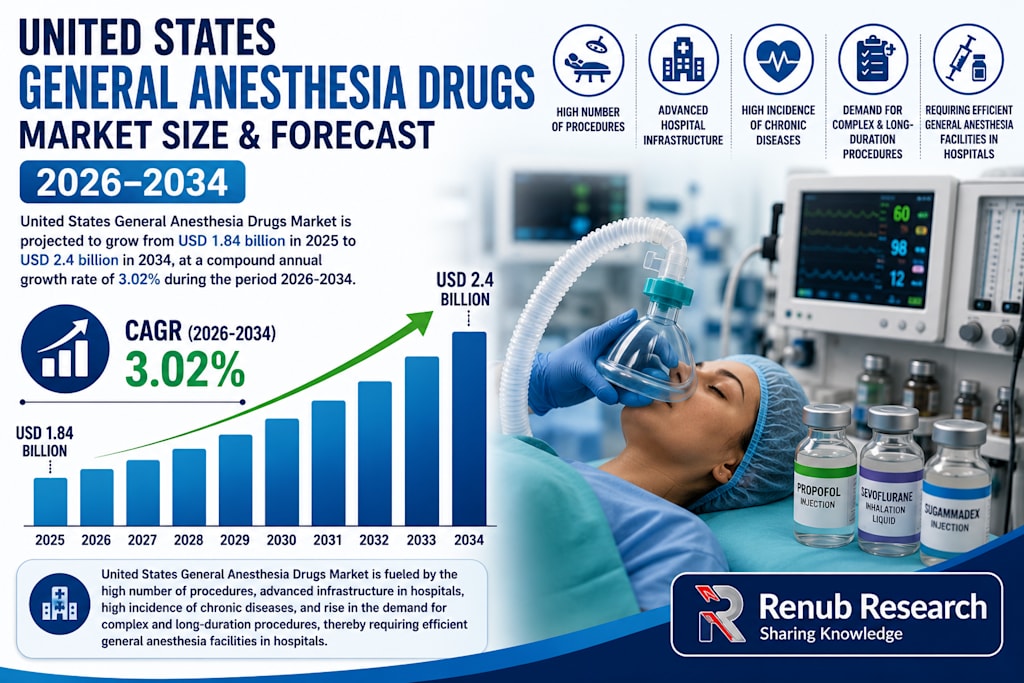
According to the Renub Research market brief provided, the United States General Anesthesia Drugs Market is projected to grow from USD 1.84 Billion in 2025 to USD 2.4 Billion in 2034, registering a compound annual growth rate (CAGR) of 3.02% from 2026 to 2034.
The market’s steady growth is being driven by rising surgical volumes, advanced healthcare infrastructure, increasing chronic disease prevalence, and growing demand for complex and long-duration surgical procedures across the country.
General anesthesia remains central to modern surgery
General anesthesia drugs are used to create a temporary state of unconsciousness, muscle relaxation, pain relief, and reflex suppression during surgical and diagnostic procedures. These drugs may be administered intravenously, through inhalation, or through a combination of both approaches.
The primary goal of general anesthesia is to ensure that patients remain completely unaware and immobile during surgery while surgeons carry out complex medical procedures safely and effectively.
These drugs are particularly important in major surgeries such as cardiovascular procedures, neurological operations, orthopedic surgeries, abdominal surgeries, and organ transplantation.
The United States healthcare system performs an enormous number of surgeries annually, making anesthesia drugs a foundational part of clinical care across hospitals and surgical centers.
Surgical volumes continue to rise across the country
One of the strongest drivers behind the U.S. general anesthesia drugs market is the growing number of surgical procedures being performed nationwide.
The report notes that the United States performs more surgeries than any other country globally, creating a massive and consistent demand for anesthesia drugs.
Several factors are contributing to this increase.
The prevalence of chronic diseases such as cardiovascular disorders, cancer, obesity, diabetes, and orthopedic conditions continues to rise. Many of these illnesses eventually require surgical treatment.
At the same time, the country’s aging population is increasing demand for procedures such as joint replacements, neurological surgeries, and cardiovascular operations. Older patients often require more intensive anesthesia management due to complex medical conditions and longer surgical durations.
The report highlights that hospitals such as Ochsner LSU Health Shreveport – St. Mary Medical Center, New York-Presbyterian Weill Cornell Medical Center, and University Hospital in Madison collectively performed more than 503,000 surgeries in 2023 alone.
As surgical complexity continues increasing, the role of effective anesthesia management becomes even more important.
Advanced healthcare infrastructure supports strong market demand
The United States benefits from one of the most advanced healthcare systems in the world, and that infrastructure strongly supports the anesthesia drugs market.
Modern hospitals and surgical centers are equipped with advanced operating rooms, sophisticated anesthesia delivery systems, digital monitoring platforms, and highly trained anesthesiology professionals.
Continuous investment in medical technology allows healthcare providers to use newer anesthesia drugs with improved safety profiles and better patient outcomes.
Healthcare facilities are also increasingly adopting minimally invasive surgical techniques, robotic-assisted surgeries, and precision-guided procedures that require highly controlled anesthesia management.
The report notes that GE HealthCare’s Allia™ Moveo received FDA clearance and CE marking in February 2026. The system is designed to improve mobility and precision in interventional environments and will support cardiovascular, vascular, surgical, and minimally invasive procedures.
Innovations like these reflect how technology continues shaping surgical and anesthesia practices across the country.
Demand for elective surgeries is increasing
Another major factor supporting market growth is the rising demand for elective surgeries.
Procedures such as cosmetic surgeries, bariatric surgeries, orthopedic joint replacements, and advanced outpatient procedures are becoming increasingly common in the United States.
Improved diagnostics and earlier disease detection are also contributing to higher surgical intervention rates.
At the same time, patients increasingly expect pain-free procedures, smoother recovery experiences, and safer anesthesia management. This is encouraging healthcare providers to adopt advanced anesthesia protocols and newer drug formulations.
The growth of outpatient surgical centers is also influencing anesthesia usage patterns. In June 2025, UC Davis Health opened one of the nation’s largest outpatient surgery centers, highlighting the growing scale of ambulatory surgical care in the United States.
As elective and outpatient surgeries continue expanding, demand for fast-acting and highly controllable anesthesia drugs is expected to remain strong.
Safety concerns remain a major industry challenge
Despite its essential role in surgery, the general anesthesia drugs market faces increasing scrutiny related to patient safety.
Concerns surrounding adverse drug reactions, postoperative nausea, cognitive impairment in elderly patients, and complications involving patients with multiple medical conditions have led to tighter regulatory oversight.
Regulatory agencies continue monitoring anesthesia drugs carefully, requiring pharmaceutical companies to meet increasingly strict safety and compliance standards.
This has increased research, development, and approval costs for manufacturers.
Patients are also becoming more informed about anesthesia risks, influencing treatment discussions and procedural decision-making.
The growing focus on safety is encouraging continued investment in newer anesthesia formulations, monitoring technologies, and precision dosing systems designed to reduce complications and improve patient outcomes.
Cost pressures are influencing hospital purchasing decisions
Healthcare cost management remains another important challenge affecting the market.
Hospitals and healthcare systems across the United States are under pressure to improve efficiency while controlling expenses. Value-based care models increasingly emphasize outcomes, cost optimization, and operational performance.
Generic competition has also created pricing pressure within the anesthesia drugs market.
At the same time, alternative anesthesia approaches such as local anesthesia and conscious sedation are being used more frequently for certain procedures, reducing reliance on full general anesthesia in some cases.
These economic and clinical shifts are forcing healthcare providers to balance cost considerations with patient safety and procedural requirements.
Propofol remains one of the most widely used anesthesia drugs
Among individual anesthesia agents, propofol continues to hold a critical position in the U.S. market.
Propofol is widely used because of its rapid onset, short duration of action, and smooth recovery characteristics. It is commonly used for both surgical anesthesia maintenance and procedural sedation in intensive care and diagnostic settings.
Its ability to support fast patient recovery makes it especially valuable in outpatient surgical environments where rapid discharge is important.
Although generic competition and supply chain risks affect pricing and availability, propofol remains one of the most trusted and frequently used anesthesia drugs across American healthcare facilities.
Remifentanil supports advanced surgical procedures
Remifentanil is another important segment within the market, particularly for complex and high-risk surgeries.
This ultra-short-acting opioid is commonly used during cardiovascular, neurological, and major abdominal surgeries because anesthesiologists can precisely control analgesic depth during procedures.
Its rapid metabolism also supports faster postoperative recovery, which is increasingly important in critical care and fast-track surgery programs.
Although opioid-related regulatory concerns affect prescribing practices, remifentanil’s clinical advantages continue sustaining demand in specialized surgical environments.
Desflurane remains valuable for rapid recovery procedures
Desflurane continues to play a significant role in inhalational anesthesia within specialized hospital settings.
It is especially valued for surgeries requiring rapid induction and extremely fast recovery profiles. Desflurane is commonly used for obese and geriatric patients where quick postoperative recovery is beneficial.
Although environmental concerns and higher costs have affected usage in some settings, desflurane remains important in tertiary care hospitals and academic medical centers where anesthesia precision and rapid recovery are priorities.
Intravenous anesthesia is gaining popularity
The report also highlights growing demand for total intravenous anesthesia (TIVA) in the United States.
Intravenous anesthesia allows highly controlled dosing while reducing postoperative nausea and improving patient comfort during recovery.
TIVA is increasingly used in outpatient surgical centers and minimally invasive procedures because it supports efficient recovery and high patient satisfaction.
Advances in monitoring technology are further improving the safety and precision of intravenous anesthesia administration.
Hospitals remain the largest end-user segment
Hospitals continue to dominate the U.S. general anesthesia drugs market because they perform the majority of complex and high-risk surgeries.
Large hospital systems are equipped with advanced operating rooms, anesthesia monitoring systems, and highly trained medical professionals capable of handling specialized surgical procedures.
Hospitals also serve as primary centers for cardiac surgeries, transplant procedures, neurosurgery, trauma care, and other interventions requiring full general anesthesia.
The increasing burden of chronic disease and the rising number of elderly patients continue supporting long-term hospital demand for anesthesia drugs.
State-level markets are evolving differently
California represents one of the largest regional markets due to its large population, advanced healthcare infrastructure, and strong life sciences industry. High surgical volumes and widespread use of ambulatory surgery centers continue supporting demand.
New York also remains a major market because of its concentration of large hospitals, high-density urban populations, and significant number of complex surgeries performed annually.
Washington benefits from strong healthcare systems and increasing demand for orthopedic, general, and specialty surgeries. The state’s emphasis on quality care and advanced technology continues supporting steady growth.
Arizona is experiencing rapid growth due to healthcare infrastructure expansion, population growth, and increasing demand from its aging population. Orthopedic, cardiovascular, and minimally invasive procedures are all contributing to rising anesthesia drug usage.
The future of anesthesia will focus on precision and patient safety
The U.S. general anesthesia drugs market is evolving alongside broader healthcare trends.
Future growth will likely depend on safer drug formulations, advanced monitoring technologies, personalized anesthesia management, and greater operational efficiency within surgical care environments.
Healthcare providers increasingly want anesthesia systems that improve outcomes, reduce recovery time, and minimize complications.
At the same time, hospitals continue balancing rising surgical demand with financial pressures and regulatory expectations.
This creates ongoing opportunities for innovation across pharmaceuticals, anesthesia delivery systems, and perioperative care technologies.
Final Thoughts
The United States general anesthesia drugs market continues growing because surgery itself is becoming more advanced, more accessible, and more specialized.
With the market projected to rise from USD 1.84 Billion in 2025 to USD 2.4 Billion by 2034, anesthesia drugs will remain a critical part of modern healthcare infrastructure.
Although safety concerns, regulatory scrutiny, and cost pressures remain challenges, rising surgical demand and continued healthcare modernization are expected to support long-term market stability.